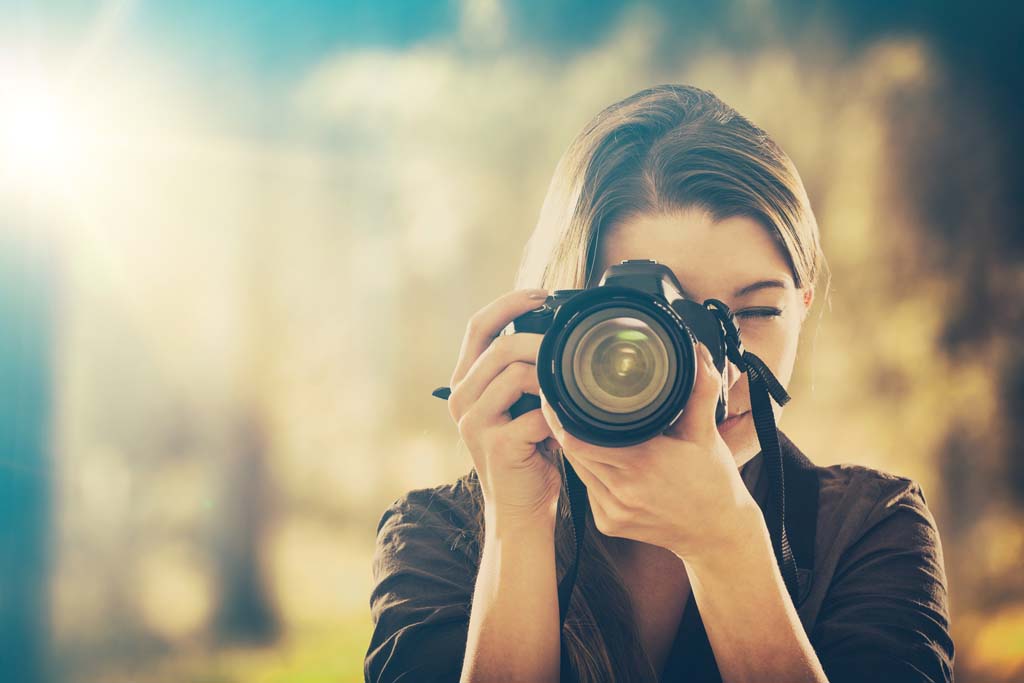
Certificate in Photography
Professional training in photography. Learn the skills required to work in this industry - the tech skills needed to take photos, sell photographic supplies, process photos or manage a photo industry business.

Study Photography at Home
Learn the skills required to work taking photos, selling photographic supplies, processing photos or managing a photo industry business.
This course was developed by professional photographers. It covers lessons in photographic technology, photographic practice and various electives.
This is a rapidly changing industry; and our courses are continuously updated to keep pace with these changes.
It will give you a sound foundation for a career in the photographic industry.
Student Comment (from N. Huettmann, Germany)
"Yes, I do learn a lot....I'm absolutely satisfied....because I already run my own business as a photographer, the freedom to handle the course whenever I find the time is just great".
Your assignments are practical and tutors provide individual feedback on your images.
Course Structure
This course is made up of a number of modules. To complete this course you must study and pass all of the modules listed below.
Core Modules
- Introduction To Photography
- Photographic Practice
- Photographic Technology
- Photoshop CS - Beginner To Medium Level
Elective Modules
In addition to the core modules, students must also choose 2 of the following elective modules.
Accreditations
What is Photography?
Photography is 'capturing an image'. Many different technologies can produce images. The quality of those images will eventually be judged by our own eyes. This interaction between eye and lens, the relationship between photographer and subject must be developed (alongside your technical skill) to create outstanding photos.
Course Structure
The certificate consists of six modules covering:
- The principles underpinning photography and its evolution into digital technologies.
- How photographic images are captured on film.
- How photographic images are captured by digital cameras.
- How to improve your photographs.
- The appropriate use of photographic equipment.
- How digital images can be transferred effectively from a digital camera.
- How photographic film is developed.
- Enlarging photos.
- Altering digital photos.
- Working with light when taking photos.
- Identifying and avoiding common faults in photographs.
- Composing photographs to match a predetermined aim.
- Taking better photos of people.
- Taking better photos of landscapes and other natural subjects.
- Appropriate use of colour and black and white photography.
- Visual affects using special techniques.
- Taking better photographs for use in print or electronic media.
- Business opportunities in photography.
- Describe in technical terms, how an image forms when a photograph is taken.
- The nature of light and how this relates to the finished photographic product.
- How photo sensitive surfaces work.
- Manipulation of white and coloured light to create different photographic images.
- The chemical process that occurs in producing a colour film photograph.
- How the photographic image may be manipulated by using optical filters or other camera attachments, other than lenses.
- How the photographic image may be manipulated by using lenses.
- Appropriate equipment for use in digital photography.
- How digital images are captured.
- Comparing different digital cameras and selecting an appropriate camera for a particular application.
- Controlling the effects in a digital photograph.
- Capturing images from film, photographs, or graphics.
- Transferring digital images to a computer, video monitor, television set, etc.
- Processing digital photographs to achieve improved or altered images.
- Digital special effects.
- Opening digital files using Photoshop.
- Resizing images and saving them in multiple file formats.
- Creating original graphics using the Photoshop tools.
- Manipulating individual elements of a graphic composition or image.
- Improving the quality of an image - cleaning it up.
- Applying interesting filters and effects.
- Preparing your files for the web, print or email.
- The nature of lighting as relevant to photography.
- How different light sources will affect your images.
- Using filters to create different lighting effects.
- Different types of light meters.
- Equipment for achieving more desirable light conditions for photography.
- How to compensate for imperfect light conditions.
- Studio lighting versus location lighting.
NOTE: You Can Choose other options to several of the modules above.
This is a very flexible course, so talk to us and put together a combination of modules that suits.
LEARN TO TAKE MORE CHALLENGING PHOTOS
Anyone can take a photo; particularly today, where every phone lap top and i-pad contains a reasonable camera built in.
It's a completely different thing though, to be able to decide what to take, what to exclude, then how to capture the image in a way that creates something extraordinary.
When you start getting serious about photography, you will begin to see possibilities and challenges that you probably didn't even imagine before though. Some situations you may have assumed would be easy, can in the heat of the moment become a far more challenging proposition.
This may be exactly why you need to study photography!
Coping with the difficulty created by variations in the subject (e.g. movement), the available equipment, or the conditions (eg. weather, light); is one thing. Sometimes though, the challenges of variable conditions can also bring opportunities to create very special images.
Learn How Movement Can Complicate the Way You Photograph
Action photography can be used to photograph any subject which is in movement or motion. This may be anything from children on their bikes, cars, athletes and is extremely beneficial to use at sporting events. Any image where the subject may be in motion increases the chance that your photographs may be blurred.
You will need to be prepared in advance when you are photographing action shots. You may choose to use film or digital, however digital does have its positive advantages over conventional cameras when shooting action shots. Digital allows you to increase settings such as the ISO much easier, you are able to view the images, you do not need to carry lots of rolls of film around and you can takes lots more images.
Professional sports photographers realise the advantage digital technology has over conventional photography in this area. With sports photographers racing to get their images into newspapers and magazines as quickly as possible, digital images can be sent down the line directly to the picture desk, cutting out the time it takes to process and deliver images.
To photograph action shots, you will require:
- A higher ISO (film or digital).
- A fast shutter speed (varies depending on how fast the motion is).
- A telephoto lens is good.
Sports Action Photography
Photographing athletes and sports can require patience and skill at being able to capture the right moment in time, and capture just the right amount of movement.
You will need to set your camera on a fast shutter speed:
- 1/500th second will do for slower sports.
- 1/1000th second or more may be needed for the faster sports such as skiing.
A telephoto lens (180 or 200mm focal length). Over a 200mm lens is difficult for action photography as it usually requires a tripod or monopod at least.
Although slow fine grain film can be used in bright sunny conditions, a faster (say ISO 400) film is usually far more suited to capture sports photography. With digital, it is a lot easier to bump up your ISO depending on the speed of the sport you are photographing, so try setting the ISO to 800, if you are getting blurred images then increase this. 1600 ISO is a happy medium with most sports so you can capture all the action. The good thing about digital is that you can increase the ISO as high as 3200 if needed. Depending on the digital SLR camera you are using, you may get noisy results in your images, due to too high an ISO. If you are shooting in low lights, or even at night, then a high ISO may be a problem. You will need to try and compensate this by opening up the aperture on the lens and camera.
If lighting is artificial, in an indoor event, you should give consideration to the colour balance (Tungsten film or an 80A filter might be needed). To get around this issue in digital shoot in RAW as you can adjust the colour balance in post-production without regarding the image.
Freezing Action
The shutter speed and distance from the camera interrelate. Action that is moving towards you or away from you appears to move slower than action moving across your cameras field of vision at a right angle to the lens axis. As a result, shooting action head on can be shot with a slower shutter speed to freeze action than shooting from the side.
For example, a cyclist 100ft from the camera traveling at 30 M.P.H. might be frozen by 1/250th second shutter speed. However, if you are only 20ft away, the cyclist will appear to be moving faster and you might need a shutter speed of 1/1000th of a second.
Sometimes it appears that the action during a sport is temporarily suspended in time, for example, when a skate boarder reaches the top of the ramp there will be a slight pause because his upwards motion has finished and inertia suspends him temporarily before gravity pulls him back down again. If you are ready for this pause you can freeze the moment using a slower shutter speed.
Blurring Movement
To blur images to convey motion it is usually best to keep the background sharp or at least recognizable. The shutter speed you chose is dependent on the speed at which your subject is moving. Most movement of people will be adequately blurred at 1/30th second, yet keep some of the image in focus. Shutter speeds slower than 1/30th second will blur all or most of the image, and usually you will need to use a tripod to keep some of the background sharp. Remember that action closer to you will be faster than action further away, and that the fastest moving parts of the body will be the most blurred. If you are blurring action outdoors and the light is bright you will want to use a slow film or set your digital camera at its slowest ISO.
Panning
By using the panning technique you can create the effect of movement by shooting a relatively sharp subject against a blurred background. To ensure a crystal clear shot when shooting fast sports such as motor racing, start to focus on the subject from some distance away and keep on tracking the subject until it is at the spot on the track where you wish to take the photo. Now, press the shutter button and to avoid blurring the shot, keep on tracking (panning) with the subject until the shot has been recorded. Practice is essential to get this technique right. Panning needs a fairly slow shutter speed and is therefore suited to low light conditions. You can modify this using slow film or camera ISO, and you may wish to use filters to reduce the light. In general, the slower the subject is moving the longer the exposure you will need. At slow shutter speeds, you can use a tripod with a panning head, which will decrease your chances of jarring the camera vertically.
WHAT WILL THIS COURSE DO FOR YOU?
- Improve your technical photographic skills.
- Understand the industry.
- Prepare yourself for a career in the industry.
- Learn communication skills.
- Learn business skills.
Enrol using the automated procedure on this site or contact us via phone or email to ask questions and enrol with a real person.
You can enrol at anytime and start the course when you are ready. Enrolments are accepted all year - students can commence study at any time. All study is self paced and ACS does not set assignment deadlines.
Please note that if a student is being assisted by someone else (e.g. an employer or government subsidy), the body offering the assistance may set deadlines. Students in such situations are advised to check with their sponsor prior to enrolling. The nominal duration of a course is approximately how long a course takes to complete. A course with a nominal duration of 100 hours is expected to take roughly 100 hours of study time to complete. However, this will vary from student to student. Short courses (eg. 100 hrs duration) should be completed within 12 months of enrolment. Certificates, Advanced Certificates and Awards (eg. over 500 hours duration) would normally be completed within 3 -5 years of enrolment. Additional fees may apply if a student requires an extended period to complete.
If a student cannot submit their assignments for 6 months to ACS, they should advise the school to avoid cancellation of their student
registration. Recommencement fees may apply.
Simply click on the ENROL OPTIONS button at the top of this screen and follow the prompts.
You can see the course price at the top of this page. Click 'enrolment options' to see any payment options available.
You can pay by Credit Card, PayPal, Afterpay or bank transfer.
Yes! We have payment plans for most courses. Click 'enrolment options' to see the available payment plans.
We also have Afterpay that will allow you to pay for your course or payment plans in four instalments (if you are in Australia).
There are no entry requirements that you need to meet to enrol in our courses, our courses are for everyone.
If you are under 18, we need written permission from your parent/ guardian for your enrolment to continue, we can arrange that after you have enrolled.
You don’t need to purchase any additional resources to complete our courses.
What do I need to know before I enrol?
We aim to teach you the essentials without you having to purchase any specific computer program.
We recommend that you have access to a word processing program, such as Microsoft Word or Google Docs, so that you can easily complete and submit your assignments.
You sure can. We are here to help you learn whatever your abilities.
Yes, if you are enrolling in a Certificate or Advanced Certificate, you might be eligible for credits if you have evidence of your previous studies or relevant experience. More information is here.
We recommend that you are able to browse websites, send emails and conduct online research. You will need to be able to type and submit your assignments.
If you have limited computer skills, we can make special arrangements for you.
This is possible, it depends on the institution. We recommend that if you would like to use our courses that you contact the institution first. Our Course Handbook is a good resource for this.
Our courses are written in English and we only have English speaking academic staff. If you can read and complete your assignments in English, our courses are ideal for you.
Our courses are designed to build knowledge, hands on skills and industry connections to help prepare you to work in the area, running your own business, professional development or as a base for further study.
This course is aimed at providing you with a solid understanding in your selected discipline. It has been designed to take 600 hours, which includes your course reading, assignment work, research, practical tasks, watching videos and more. When you complete the course, will have a good understanding of the area/ industry you want to work in.
It’s up to you. The study hours listed in the course are a rough guide, however if you were to study a short course (100 hours) at 10 hours per week, you could finish the course in 10 weeks (just an example). Our courses are self-paced, so you can work through the courses in your own time. We recommend that you wait for your tutor to mark and return your assignment before your start your next one, so you get the benefits of their feedback.
The course consists of course notes, videos, set tasks for your practical work, online quizzes, an assignment for each lesson (that you receive feedback from your tutor from) and ends in an exam (which is optional, if would like to receive the formal award at the end), using our custom built Learning Management System - Login.Training.
Our courses are designed for adults to gain professional development and skills to further their careers and start businesses.
Our custom online learning portal allows you to conduct your learning online. There may be practical tasks that you can do offline. You have the option of downloading your course notes or print them to read later.
There is also the option to pay an additional fee for printed course notes and or USB (availability limited to location and deliverability).
Yes, if you don’t have access to the internet, you can receive the course as paper notes or on a USB stick for an additional fee. We can also make alternative arrangements for you to send your assignments to us.
We offer printed notes for an additional fee. Also, you can request your course notes on a USB stick for an additional fee.
Yes, your tutor is here to help you. Simply post any questions you have in your login.training portal or contact the office and we can pass on a message to your tutor.
We are more learning focussed, rather than assessment focussed. You have online quizzes to test your learning, written assignments and can complete an exam at the end of the course (if you want to receive your certificate). You will not receive a pass/ fail on your course work. If you need to add more details on your assignment, we will ask you to resubmit and direct you where you need to focus. If you need help, you can ask your tutor for advice in the student room.
Each module (short course) is completed with one exam.
Exams are optional, however you must sit an exam if you would like to receive a formal award. You will need to find someone who can supervise that you are sitting the exams under exams conditions. There is an additional cost of $60 incl. GST for each exam.
More information is here
There are practical components built into the course that have been designed to be achieved by anyone, anywhere. If you are unable to complete a task for any reason, you can ask your tutor for an alternative.
When you complete the course work and the exams (6 exams) and you will be able receive your course certificate- a Certificate. Otherwise, you can receive a Letter of Completion.
You can bundle the short courses to create your own customised learning bundle, Certificates or Advanced Certificates. More information is on this page.
Yes, our courses are built to be applicable for people living anywhere in any situation. We provide the fundamentals, and each student can apply their own unique flair for their own interests, region and circumstances with the one-on-one guidance of a tutor. There is also a bit of student directed research involved.
Employers value candidates with industry skills, knowledge, practical skills and formal learning. Our courses arm you with all of these things to help prepare you for a job or start your own business. The longer you study the more you will learn.
ACS has an arrangement with OAMPS (formerly AMP) who can arrange Professional Indemnity from Australian and New Zealand graduates across all disciplines. Ph: 1800 222 012 or email acs@oamps.com.au.
Who are ACS Distance Education?
ACS Distance Education have been educating people for over 40 years.
We are established and safe- we have been in education for over 40 years.
We are focused on developing innovative courses that are relevant to you now and what you will need to know in the future.
We are focused on helping you learn and make the most of your experience.
You can enrol at any time, you can work on your course when it suits you and at your own pace.
We are connected to many industry bodies and our staff participate in continuous improvement and learning activities to ensure that we are ahead of what learning is needed for the future.
Our courses are not accredited by the Australian Government. However many of our courses are recognised and held in high regard by many industry bodies.
Our courses are written by our staff, who all have many years experience and have qualifications in their speciality area. We have lots of academic staff who write and update our courses regularly.
How do I enrol my staff/ sponsored students?
Yes, you can do a request for a bulk enrolment and request an invoice on our Invoice Request Form
We can prepare an invoice, quote or proforma invoice. Simply complete your details on our Invoice Request form
We can arrange bulk discounts for your course enrolment, please get in touch with us to discuss your needs.
Yes, we have many students who are in locked facilities, such as prisons or hospitals. We can cater by also offering paper notes at an additional cost.
What if I have any more questions or need more information?
We can assist you to find the right course for your needs. Get in touch with us via email (admin@acs.edu.au) call on +61 7 5562 1088 or complete our course advice form.
What if I change my mind?
Please get in touch with studentservices@acs.edu.au if you would like to be removed from our mail list.
If you would like ACS Distance Education to delete your information at any time (whether you are a customer or a prospective customer), please contact our privacy officer and we will process this ( admin@acs.edu.au ).
If students require a reproduction of their certificate, an electronic copy can be provided at a cost of AUD$35 incl GST. Printed copies are not available.
Course Contributors
The following academics were involved in the development and/or updating of this course.
John Mason
Writer, Manager, Teacher and Businessman with over 40 years interenational experience covering Education, Publishing, Leisure Management, Education, and Horticulture. He has extensive experience both as a public servant, and as a small business owner.
John is a well respected member of many professional associations, and author of over seventy books and of over two thousand magazine articles.

John Edwards
Professional photographer. Experienced in Environmental and Water Services management. Has traveled extensively for photography projects. John has a BA (Hons) Photography, BSc (Hons) Env.Mgt, PGCE

Josiane Joubran
CSC consultant with IBM, Software QA Engineer, Course Writer and Tutor. Josiane is an I.T professional with extensive experience with computer hardware and engineering in Lebanon and Australia. Josiane has a B.Eng., Grad.Dip.I.T., Master Info.Tech., MCP, MCSE.
Christine Todd
University lecturer, businesswoman, photographer, consultant and sustainability expert; with over 40 years industry experience
B.A., M.Plan.Prac., M.A.(Social).
An expert in planning, with years of practical experience in permaculture.
Photographic Techniques
Explore how to take better photos. This is a book packed full of practical tips, from the authors own experience, coupled with a solid introduction to well established and widely practiced photographic techniques. This is a well illustrated, excellent reference for students of photography; and an equally useful source of inspiration to the amateur photographer.
Professional Practice for Consultants
Explore becoming a consultant. This ebook contains chapters on how to be a consultant, packaging your services, delivering the services, building your resources, finding the work and getting the job, planning and ethics.

Working with People
Are you a people person? Some people enjoy working with others, some do not, but if you do then this is the book for you. Ideal for those considering a new career but who are not sure where they should start.