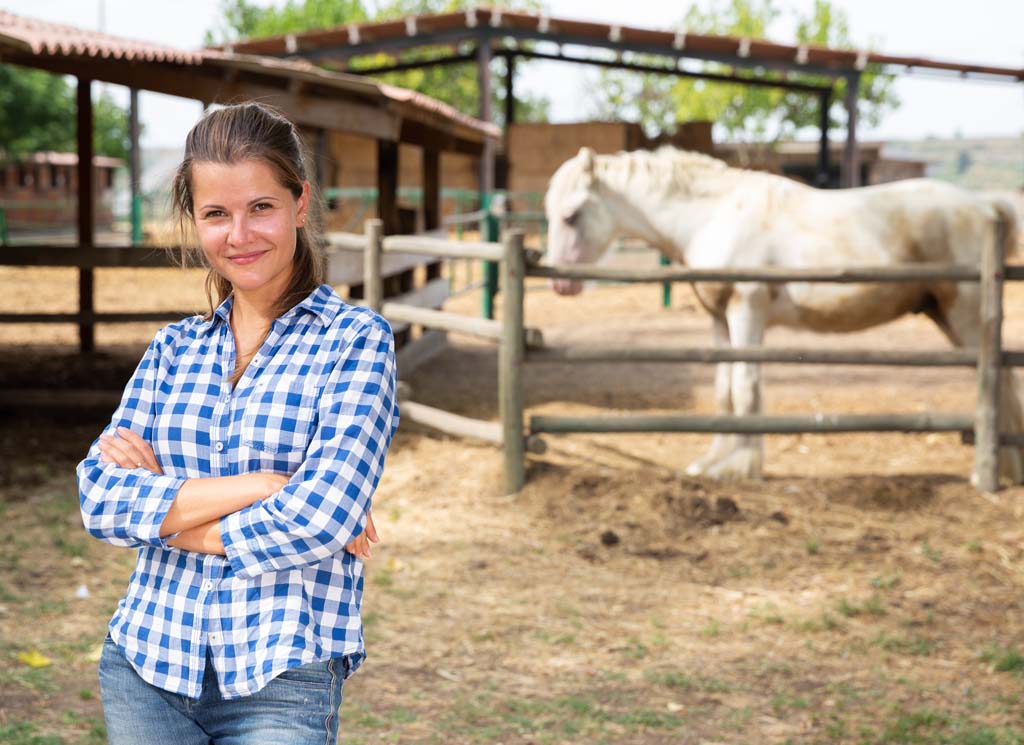

This is a solid introduction to animal health, where you learn to assess animal health, explain a variety of conditions and identify appropriate treatments or responses to a range of more common complaints or illnesses.
Aims
- Explain common health problems affecting animals, including the circumstances under which animals contract health problems, and methods used to prevent the development of ill health.
- Analyse physical indicator symptoms of ill health in animals.
- Determine the taxonomic class of animal pests and diseases.
- Explain the diagnostic characteristics of the main types of animal pathogenic microorganisms.
- Explain the methods used in the treatment of pests and diseases in farm animals.
- Explain the role of inflammation, including its symptoms and causes, in animals.
- Explain the biological processes which affect and control the immune system in animals.
- Explain the biological processes which affect and control tissue repair in animals.
- Determine procedures for the management of wounds to animals, on a farm.
- Explain the processes involved in cellular change in animals.
- Diagnose simple health problems in farm animals.
What You Will Do
- List criteria used to assess the health status, including ill-health, of animals.
- Describe the different causes of ill-health in animals.
- Explain the methods used to prevent ill-health in animals.
- Write a standard procedure for a routine health examination of a chosen farm animal.
- Describe the symptoms of ill-health in animals.
- Compare the causes of two symptomatically similar health problems for a specified farm animal.
- Diagnose a health problem from a given set of symptoms.
- Distinguish, using labelled illustrations, between different taxonomic classes of animal pest and disease organisms.
- Describe identifying characteristics of four different disease carrying agents of specified farm animals.
- Classify commonly occurring pests and diseases of three different animals, into their taxonomic classes.
- Describe the characteristics of viruses, using illustrations and a report.
- Describe the characteristics of bacteria, using illustrations and a report.
- Describe the characteristics of protozoa, using illustrations and a report.
- Describe the characteristics of parasites, using illustrations and a report.
- Describe the characteristics of nutritional disorders, using illustrations and a report.
- Analyse the relevance of ten specified factors, to determining the health of a chosen species of farm animal.
- Describe the veterinary treatments available over the counter for on-farm use.
- Explain the vaccination programs used to treat two different specifies of farm animal.
- Describe the applications and techniques used for dips, to control external parasites in a specified farm animal.
- List the essential items for a First Aid Kit for a specified farm animal.
- Write guidelines for general procedures to follow when nursing sick farm animals.
- List the procedures employed in quarantine, using a chosen animal as an example.
- Describe the procedures for slaughtering a diseased ruminant in order to conduct a post-mortem examination.
- Prepare an illustrated, one page report on the post-mortem procedures of a ruminant.
- Compare two different methods used to control a specified disease in farm animals.
- Identify a suitable method of control for ten different, specified pests and diseases of farm animals.
- Differentiate between at least five factors which cause inflammation in animals.
- Develop a checklist for analysing inflammation in a chosen farm animal species.
- Explain the inflammatory response in a specific case study.
- Compare the different methods used to control inflammation in animals.
- Describe the function of the immune system in animals.
- List the agents which can cause fevers in animals.
- Explain the biology of fevers in a specified case study of a farm animal species.
- Explain the methods used in treating fevers in animals.
- Explain at least five factors which influence immune response in animals.
- Explain the characteristics of the immune system in a chosen farm animal species.
- Describe the composition of tissues at three different body sites, in terms of susceptibility to different types of internal and external damage.
Lesson Structure
There are 10 lessons in this course:
-
Introduction to Animal Health -
- Learn to describe common diseases affecting farm animals and the circumstances under which animals contract these diseases - the healthy animal, causes of ill health, preventing ill health.
-
Signs & Symptoms of Diseases -
- The physical symptoms of diseases in farm animals - common methods of handling animals during health assessments, recognising ill health, restraining a horse, sheep handling facilities.
-
Disease Classification -
- Methods used in classifying animal diseases.
- viral diseases, bacterial diseases, parasitic diseases, protozoal diseases, disease types in beef cattle, diseases in sheep.
-
Causes and Diagnosis of Disease -
- The causes of disease and the relevant methods of diagnosis - examining cattle, examining a horse, ticks, tick-borne diseases, diagnosis of diseases.
-
Treatment of Disease -
- Methods used in the treatment of diseases in farm animals - vaccination, the animal first aid kit, tetanus antiserum, animal nursing, quarantine, slaughter, postmortem, disease prevention in cattle, disease prevention in sheep, treatment of parasites in sheep.
-
Inflammation -
- Outline the nature and causes of inflammation in farm animals - the inflammatory response, causes of inflammation, types of inflammation, symptoms of inflammation, inflammatory exudate, treatment of inflammation.
-
Fever and Immunity -
- The biological mechanisms underlying fever and the immune system in farm animals - the fever mechanism, other temperature related disorders, effect of temperature on enzymes, immunity.
-
Tissue Repair -
- The biological mechanisms underlying tissue repair in farm animals - healing of a clean incised wound, healing of an open wound, common horse ailments to recognise.
-
Wounds -
- The biological mechanisms of wounds in farm animals and address different treatment methods for repair of common ailments - types of wounds, first aid treatments, bandaging horses, emergencies.
-
Cell changes -
- The causes and biological mechanisms of cell change in farm animals - neoplasms, tumours and cancers, the course of an infectious disease, death, cancers, etc.
Accreditations
What Causes Ill Health in Animals?
Injury
An injury can cause disease in two different ways:
- The animal may be injured in a way that it cannot function properly. The injury might be localised (e.g. a bruise or lameness), which can be treated and put right fairly easily); or it may be severe (e.g. a broken leg), which could require the animal to be destroyed. In general, treating serious injuries is a matter of economics on the farm. If the cost of treatment is greater than the value of the animal, then the animal may be best destroyed.'
- The injury may cause tissues to be exposed through wounds, which subsequently become infected by bacteria and other organisms. Examples of such diseases include blood poisoning, septic wounds, gangrene and tetanus (lockjaw).
Poisons
Poisons cause chemical processes to occur inside the animal, which lead to degeneration and death of body cells. There are two types of poisons:
- Those present in plants eaten by animals. Some weeds which grow in pasture can be a problem and other weeds can change the flavour of milk, affecting its market value.
-
Those which are chemicals (e.g., pesticides) which contaminate the animal by accident. In some cases, an ingesting excess of a useful mineral (e.g., iron, fluorine, sulphur or selenium) can cause poisoning.
Hereditary Conditions
Inherited characteristics can cause certain cells in the body to degenerate. An example of this is "dwarfing" in calves.
Nutritional Problems
Feeding is a factor which has a great effect on the health of farm animals, in any of the following ways:
-
Feeding too little or too much food to the animal. Too little food will cause a loss of production from the animal, and in severe cases may lead to malnutrition and death from starvation. Over feeding can lead to animals becoming over fat and unhealthy.
-
Feeding a ration which is not balanced for the particular animal's needs. Deficiencies of protein, major minerals, trace elements, vitamins, and even water; can lead to many different deficiency diseases.
-
Feeding a ration that contains a substance that is toxic to the animal.
-
Allowing the animal to eat food or to drink water that has been contaminated by bacteria or by parasites such as worms.
-
The health of the animal can be affected positively by feeding a diet that increases its resistance to bacterial disease.
Living Organisms
This is the commonest cause of ill health in animals, and the organisms involved are:
- Microorganisms - such as bacteria, fungi, viruses and protozoa.
- Parasites - such as worms, ticks, lice and insects.
Microorganisms
- Bacteria
Bacteria are small organisms belonging to the plant kingdom. They consist of single cells, but when they multiply, cells often remain joined together, so that they appear to be multicellular.
Bacteria reproduce in a very simple way: The bacteria enlarge, and a cell wall develops across the middle. The two new halves then separate to become two new bacteria.
This process can be completed in twenty minutes, so that if conditions are good and plenty of food is available, thousands of millions of bacteria can be produced from a single cell in 24 hours. This very rapid multiplication accounts for the rapid course of a disease, and the way in which a disease can spread throughout a herd in a short time.
Examples of diseases caused by bacteria include anthrax, brucellosis, lumpy jaw, mastitis and tetanus. It must be emphasised, however, that not all bacteria cause disease. Many live inside or on the skin of an animal and cause no ill effects.
- Fungi
Fungi are plants. Some are large (e.g., mushrooms), and others are so small that they can only be seen under a microscope. They start from a single cell and spread by simple division to form long threads. Fungi also produce spores which are released and spread the disease over a wide area. Ringworm is an example of a disease caused by a fungus.
- Viruses
Viruses are the smallest living organisms at present know. Viruses are a most highly infectious form of disease. They live within the cells of other living organisms, and as such are difficult to treat without also affecting the cells which they inhabit. Viruses are highly infectious.
Examples of virus diseases include: swine fever, foot and mouth disease, fowl pest, cattle plague and the common cold.
- Protozoa
Protozoa are single cells, but unlike bacteria, they are animals. There are many different kinds of protozoa, some of which cause diseases in humans or in animals. In many cases, the disease is transmitted by flies or other insects.
Examples of diseases caused by protozoa include: Redwater (transmitted by ticks), East Coast Fever and Sleeping Sickness (transmitted by the tsetse fly in Africa) and malaria in humans (transmitted by insects).
Parasites
Parasitic Worms (Helminths) are invertebrate multicellular animals. There are two types of parasitic worms:
- Roundworms
- Flatworms (Flukes or Tapeworms)
Worms often have complex life cycles, spent partly in the infested animal, and partly outside (either in a different animal, or not inside any organism). When inside an animal, they may remain in the one part of the body, or they may travel, passing through different organs.
Wherever worms are in a body, they are a foreign system, competing with the body for nourishment. They don't reproduce as fast as bacteria or fungi, but a single organism is much larger and can cause a lot of damage. They can still reproduce relatively fast, and may develop into large numbers over a relatively short period. When worms are present in an animal, they usually cause ill health either by using the food the animal would have otherwise used; or by directly damaging an organ, or tissue.
All worms are classified as endoparasites because they live inside their animal host.
External parasites include ticks, lice and various other Insects. They are collectively called ectoparasites, because they live outside the host animal; either biting or sucking blood from the animal. This group can be divided into two:
- Arachnids - ticks and mites (adult ticks and mites have eight legs)
- Insects (adult insects have six legs)
How the Course can Benefit You?
Studying Animal Health enables you to understand the needs of animals in your care and how to recognise illness and make informed decisions for the best course of action in individual cases.
This course can be studied on its own…
Alternatively, this course will give you the most benefit when combined with Animal Husbandry I and Animal Husbandry III.
It can also be taken as part of a Certificate or higher-level qualification.
Why Study with ACS?
Design your own learning pathway.
Study at your own pace, from anywhere, at any time.
Receive prompt, expert support from our team of committed and friendly tutors.
Your learning is our priority. We are flexible and adaptable to meet your educational needs!
Enrol using the automated procedure on this site or contact us via phone or email to ask questions and enrol with a real person.
You can enrol at anytime and start the course when you are ready. Enrolments are accepted all year - students can commence study at any time. All study is self paced and ACS does not set assignment deadlines.
Please note that if a student is being assisted by someone else (e.g. an employer or government subsidy), the body offering the assistance may set deadlines. Students in such situations are advised to check with their sponsor prior to enrolling. The nominal duration of a course is approximately how long a course takes to complete. A course with a nominal duration of 100 hours is expected to take roughly 100 hours of study time to complete. However, this will vary from student to student. Short courses (eg. 100 hrs duration) should be completed within 12 months of enrolment. Certificates, Advanced Certificates and Awards (eg. over 500 hours duration) would normally be completed within 3 -5 years of enrolment. Additional fees may apply if a student requires an extended period to complete.
If a student cannot submit their assignments for 6 months to ACS, they should advise the school to avoid cancellation of their student
registration. Recommencement fees may apply.
Simply click on the ENROL OPTIONS button at the top of this screen and follow the prompts.
You can see the course price at the top of this page. Click 'enrolment options' to see any payment options available.
You can pay by Credit Card, PayPal, Afterpay or bank transfer.
Yes! We have payment plans for most courses. Click 'enrolment options' to see the available payment plans.
We also have Afterpay that will allow you to pay for your course or payment plans in four instalments (if you are in Australia).
There are no entry requirements that you need to meet to enrol in our courses, our courses are for everyone.
If you are under 18, we need written permission from your parent/ guardian for your enrolment to continue, we can arrange that after you have enrolled.
You don’t need to purchase any additional resources to complete our courses.
What do I need to know before I enrol?
We aim to teach you the essentials without you having to purchase any specific computer program.
We recommend that you have access to a word processing program, such as Microsoft Word or Google Docs, so that you can easily complete and submit your assignments.
You sure can. We are here to help you learn whatever your abilities.
Yes, if you are enrolling in a Certificate or Advanced Certificate, you might be eligible for credits if you have evidence of your previous studies or relevant experience. More information is here.
We recommend that you are able to browse websites, send emails and conduct online research. You will need to be able to type and submit your assignments.
If you have limited computer skills, we can make special arrangements for you.
This is possible, it depends on the institution. We recommend that if you would like to use our courses that you contact the institution first. Our Course Handbook is a good resource for this.
Our courses are written in English and we only have English speaking academic staff. If you can read and complete your assignments in English, our courses are ideal for you.
Our courses are designed to build knowledge, hands on skills and industry connections to help prepare you to work in the area, running your own business, professional development or as a base for further study.
This course has been designed to cover the fundamentals of the topic. It will take around 100 hours to complete, which includes your course reading, assignment work, research, practical tasks, watching videos and anything else that is contained in the course. Our short courses are a great way to do some professional development or to learn a new skill.
It’s up to you. The study hours listed in the course are a rough guide, however if you were to study a short course (100 hours) at 10 hours per week, you could finish the course in 10 weeks (just an example). Our courses are self-paced, so you can work through the courses in your own time. We recommend that you wait for your tutor to mark and return your assignment before your start your next one, so you get the benefits of their feedback.
The course consists of course notes, videos, set tasks for your practical work, online quizzes, an assignment for each lesson (that you receive feedback from your tutor from) and ends in an exam (which is optional, if would like to receive the formal award at the end), using our custom built Learning Management System - Login.Training.
Our courses are designed for adults to gain professional development and skills to further their careers and start businesses.
Our custom online learning portal allows you to conduct your learning online. There may be practical tasks that you can do offline. You have the option of downloading your course notes or print them to read later.
There is also the option to pay an additional fee for printed course notes and or USB (availability limited to location and deliverability).
Yes, if you don’t have access to the internet, you can receive the course as paper notes or on a USB stick for an additional fee. We can also make alternative arrangements for you to send your assignments to us.
We offer printed notes for an additional fee. Also, you can request your course notes on a USB stick for an additional fee.
Yes, your tutor is here to help you. Simply post any questions you have in your login.training portal or contact the office and we can pass on a message to your tutor.
We are more learning focussed, rather than assessment focussed. You have online quizzes to test your learning, written assignments and can complete an exam at the end of the course (if you want to receive your certificate). You will not receive a pass/ fail on your course work. If you need to add more details on your assignment, we will ask you to resubmit and direct you where you need to focus. If you need help, you can ask your tutor for advice in the student room.
Each module (short course) is completed with one exam.
Exams are optional, however you must sit an exam if you would like to receive a formal award. You will need to find someone who can supervise that you are sitting the exams under exams conditions. There is an additional cost of $60 incl. GST for each exam.
More information is here
There are practical components built into the course that have been designed to be achieved by anyone, anywhere. If you are unable to complete a task for any reason, you can ask your tutor for an alternative.
When you complete the course work and the exam and you will be able receive your course certificate- a Statement of Attainment. Otherwise, you can receive a Letter of Completion.
You can bundle the short courses to create your own customised learning bundle, Certificates or Advanced Certificates. More information is on this page.
Yes, our courses are built to be applicable for people living anywhere in any situation. We provide the fundamentals, and each student can apply their own unique flair for their own interests, region and circumstances with the one-on-one guidance of a tutor. There is also a bit of student directed research involved.
Employers value candidates with industry skills, knowledge, practical skills and formal learning. Our courses arm you with all of these things to help prepare you for a job or start your own business. The longer you study the more you will learn.
ACS has an arrangement with OAMPS (formerly AMP) who can arrange Professional Indemnity from Australian and New Zealand graduates across all disciplines. Ph: 1800 222 012 or email acs@oamps.com.au.
Who are ACS Distance Education?
ACS Distance Education have been educating people for over 40 years.
We are established and safe- we have been in education for over 40 years.
We are focused on developing innovative courses that are relevant to you now and what you will need to know in the future.
We are focused on helping you learn and make the most of your experience.
You can enrol at any time, you can work on your course when it suits you and at your own pace.
We are connected to many industry bodies and our staff participate in continuous improvement and learning activities to ensure that we are ahead of what learning is needed for the future.
Our courses are not accredited by the Australian Government. However many of our courses are recognised and held in high regard by many industry bodies.
Our courses are written by our staff, who all have many years experience and have qualifications in their speciality area. We have lots of academic staff who write and update our courses regularly.
How do I enrol my staff/ sponsored students?
Yes, you can do a request for a bulk enrolment and request an invoice on our Invoice Request Form
We can prepare an invoice, quote or proforma invoice. Simply complete your details on our Invoice Request form
We can arrange bulk discounts for your course enrolment, please get in touch with us to discuss your needs.
Yes, we have many students who are in locked facilities, such as prisons or hospitals. We can cater by also offering paper notes at an additional cost.
What if I have any more questions or need more information?
We can assist you to find the right course for your needs. Get in touch with us via email (admin@acs.edu.au) call on +61 7 5562 1088 or complete our course advice form.
What if I change my mind?
Please get in touch with studentservices@acs.edu.au if you would like to be removed from our mail list.
If you would like ACS Distance Education to delete your information at any time (whether you are a customer or a prospective customer), please contact our privacy officer and we will process this ( admin@acs.edu.au ).
If students require a reproduction of their certificate, an electronic copy can be provided at a cost of AUD$35 incl GST. Printed copies are not available.
Course Contributors
The following academics were involved in the development and/or updating of this course.

Dr. Gareth Pearce
Veterinary scientist and surgeon with expertise in agriculture and environmental science, with over 25 years of experience in teaching and research in agriculture, veterinary medicine, wildlife ecology and conservation in the UK, Australia and New Zealand. Post-graduate qualifications in Education, Wildlife Conservation Medicine, Aquatic Veterinary Studies and Wildlife Biology & Conservation.
Gareth has a B.Sc.(Hons), B.V.Sc., M.A., M.Vet.S,. PhD, Grad. Cert. Ed.(HE), Post-Grad.Cert. Aq.Vet.Sc., Post-Grad. Cert. WLBio&Cons., Dipl. ECPHM, MRCVS.
Horse Care
This book is an accumulation of information from biology, agricultural science and veterinary medicine. It looks to explore and explain the fundamentals of appropriate horse care aims and techniques. In doing so it will consider horsemanship as a combination of art and science.
Poultry
Poultry are entertaining as pets and life sustaining as a commercial product! Whether you are seeking a book as a beginner poultry keeper or if you are embarking on a new career in poultry production or management, this book is for you. Easy to read, easy to understand and packed with easy to implement practical advice. Know how to care for the health and wellbeing of poultry and make production a commercially viable enterprise.

Animal Health 2nd edition
Understand health issues, disease and injury prevention, inspecting animals, differential diagnosis and common illnesses. Animals can suffer from injury, poisoning, hereditary conditions, nutritional problems and viral, bacterial and fungal infections. A book for managing pets, farm animals, or wildlife.
Caring for Dogs
Covers Breeds, Creating a healthy home for dogs, legal issues, dog biology, recognising poor health, parasites, illnesses, nutrition, reproduction, dog psychology, behavioural development, training tips, behaviour problems, grooming, working in the dog industry, and more. This is a book for dog owners, students and anyone interested in working with dogs. 79 pages, 71 colour photos.