Landscaping II
Add to your landscape skills and knowledge. Professional development for landscapers. Learn about landscape elements in greater detail and where and how to use different types of plants. Aim to boost your understanding of design.
 A garden is like a Jigsaw Puzzle - Made Up of Pieces
- The first step in landscaping is to choose the right pieces to use.
- The next step is to arrange them together in the best way
The pieces or components of any landscape might include living plants plus any non living material such as soil, rocks, gravel, wood, brick, water, metal, or anything else your imagination can conjure up.
Learn to choose the best components for the space you are dealing with; then how to use them for the best effect.
“Less generic than Landscaping I, this course is more heavily weighted towards individual landscape components such as specific types of plants, paths, paving, walls, and garden features. It also covers landscape planning and management. This course need not follow its predecessor as it serves well as a stand alone module for landscapers, designers, and garden enthusiasts.” - Gavin Cole B.Sc., Psych.Cert., Cert.Garden Design, MACA, ACS Tutor.
Aims
- Determine the resources required for a landscape development, including materials and equipment.
- Determine appropriate plants for different locations within a landscape.
- Determine the appropriate design and construction for landscape features, including walls, fences, pavers and buildings.
- Determine treatments for problem areas in a landscape, including slopes and hostile environments.
- Analyse maintenance requirements for a landscape.
- Develop a landscape development plan, in accordance with a client brief, and in liaison with the client.
- Plan the management of a landscape projects.
What You Will Do
- Determine landscape materials readily available in the learners locality, including: soils, gravels, mulches and timbers.
- Differentiate between landscape applications for twenty different types of timber.
- Compare a range of materials in terms of function and aesthetics, including five types of mulches and five types of gravels.
- Determine applications for five different specific items of machinery in landscape construction including a chainsaw, an earth moving machine, a rotary hoe and a tractor.
- List minimum equipment required to construct two different landscapes in accordance with project specifications.
- Determine criteria for selecting plants to be planted in 3 specified locations.
- Explain the impact of trees in two specific landscapes, on both the environment and aesthetics of those landscapes.
- Determine twenty different herbaceous plants, to grow in three different specified locations within the same garden.
- Prepare a design for an annual flower display bed of 50 sq. metres.
- List five groundcovers suited to plant in four different situations, including full shade, half shade, full sun and hanging baskets.
- Prepare a planting design for a 100 sq. metre area of garden, using only groundcovers and trees.
- List ten trees suited to each of the following cultural situations, in your locality: waterlogged soil; sandy soil; heavy soil; saline soil; fire prone sites and near drainage pipes.
- Explain local government regulations which are relevant to landscape design and construction.
- Develop design criteria for different garden structures, in specified situations, including: a pergola, swimming pool, steps and a garden seat.
- Compare the design and construction of six different types of barriers, including walls and fences.
- Design a fence for a landscape designed by you, including: construction detail drawing(s), materials specifications and a cost estimate.
- Compare ten specific surfacing materials, in landscapes visited by you, including paving products, stone and gravel.
- Design a set of steps, including construction detail drawing(s), materials specifications and a cost estimate.
- Design a set of retaining walls, including construction, drawings, materials needed and a cost estimate.
- Compare different types of garden buildings observed by you, including sheds, gazebos, car ports and garages, in terms of cost, durability, aesthetics and maintenance required.
- Determine two different methods to treat a specified erosion problem.
- Determine landscape preparations required for different soil types including clay, sand, shale, rocky soil and loam.
- Describe four interim stabilisation techniques, including hydromulching and jute master.
- List fifteen plant species which will adapt well to problem situations.
- Determine ten plants suitable for each of a range of different soil types, including: clays, sands, acidic soil and alkaline soil.
- Develop landscape plans, including illustrations and written instructions, for three difficult sites.
- Determine landscape features that contribute towards the reduction of maintenance requirement on a landscaped site.
- Compare the weekly maintenance requirement of a specific low maintenance garden, with that of a specific high maintenance garden.
- Compile pre-planning information for a an existing landscape, which owners require to be redeveloped in order to reduce the maintenance requirement.
- Prepare a detailed landscape design to achieve low maintenance.
- Develop a ten week maintenance program, for a specific landscaped area visited by you.
- Compare copies of two landscape briefs for projects advertised in the tenders column of a newspaper.
- Develop a "client" brief, through an interview with a potential landscape client.
- Survey a landscape site to confirm details in a client brief.
- Develop three alternative concept plans for a landscape, in accordance with a client brief.
- Determine the preferred option, from three concept plans presented to a client at a tape recorded meeting.
- Prepare a detailed landscape design, conforming to decisions made during a discussion of alternative concept plans.
- Prepare a quotation, based on a specified landscape plan.
- Analyse the design of a landscape in comparison with the "Brief".
- Prepare a work schedule according to both specifications and plans.
- Monitor the progress of landscape work on a project, by keeping a logbook or work diary.
- Assess standard of work carried out on a completed landscape project, against landscape plans for that project.
- Select appropriate equipment, including tools and machinery, for a specified project.
- List occupational health and safety regulations when dealing with machinery and equipment, which is relevant to a specified project.
- Schedule the supply of materials and equipment for a project, in the logbook.
- Develop contingency plans for a landscape development which addresses different possible irregularities including bad weather, security problems, weekend watering.
- Explain how to finalise a specified project prior to handing over.
- Explain the importance of monitoring a contract, through a specified project.
- Develop guidelines for supervision of construction for a specified landscape project.
Lesson Structure
There are 12 lessons in this course:
-
The Garden Environment
- The ecosystem
- Microclimates
- What do you want in a garden
- Components of a garden
- Landscaping with water
- Choosing a construction method for a water garden
- Making a pool with a liner
- Other types of water gardens
- Water garden effects
- Creating a waterfall
- Cascades
- Fencing and safety
- Plants for water gardens
-
Landscape Materials
- Tools
- Tool maintenance
- Garden clothes
- Construction materials
- Concrete and cement
- How to mix concrete and mortar
- Reinforcing, rodding, expansion joints
- Gravel and mulched paths
- Outdoor furniture
- Timber: types, stains, paints, preservatives
- Plastics, Metal, Upholstery
- Furniture design
-
Using Bulbs, Annuals and other Low Growing Plants
- Annuals
- Scented annuals
- Coloured foliage
- Flower bed layout
- Bedding schemes
- Selecting annuals according to height
- Annuals in containers
- Bulbs
- Scented bulbs
- Amaryllis
- Gladioli
- Narcissus
- Dahlia
- Hyacinth
- Iris
- Ranunculus
- Using Herbs
- Types of herb gardens
-
Landscaping with Trees
- Introduction
- Successions
- Fast growing trees
- Choosing plants
- Trees in the landscape
- Problems with trees
- Plant applications for trees, shrubs, ground covers
- Trees with damaging roots
- Trees with narrow canopies
- Aesthetic criteria for planting design
- Procedure for planting design
-
Ground Cover Plants
- Introduction
- Ground Covers: conifers, climbers, creepers, ornamental grasses
- Low grasses to grow
- How to build raised beds
- Grevilleas
- Thryptomene
- Brachysema
- Chorizema
- Hardenbergia
- Kennedya
- Herbs: Thyme, chamomile, mint, alpine strawberry, etc
- Landscaping with ferns
-
Walls and Fences
- Introduction
- Getting the style right
- Different fences
- Plants to grow on trellis
- Espaliers
- Garden arches
- Choosing the rich arch
- Timber and metal arches
-
Paths and Paving
- Introduction
- Where to use surfacing
- Paving: different types of materials
- Selecting materials
- Concrete
- Gravel
- Asphalt
- Edging
- Edging materials
- Maintaining an edge
- Aesthetics
-
Treating Slopes and Other Problem Areas
- Erosion control
- Helping plants establish on a slope
- Drip irrigation, mulches, tree guards
- Pocket planting, slope serration, wattling, spray seeding, etc
- Shade
- Plants suited to shade
- Ferns and shade
- Windbreaks, hedges and screens
- Gardening in coastal areas
- Design and planting a firebreak
- Fire resistant plants
-
Garden Features
- Colour
- Complementing colours
- Outdoor living areas: Patios, seating, garden structures, pool areas, pool surrounds
- Rockeries
- Drystone walls
- Wet walls
- Garden buildings and structures
- Siting garden buildings
- What to build
- What to do with the floor
- Planting around a garden building
- Protective structures
- Types of greenhouses
- Decorative planters
- Choosing and siting a planter
- Garden lighting
- Lighting trees, paths, ponds etc
- Letterboxes
-
Designing for Low Maintenance
- Introduction
- The cost of garden maintenance
- What costs
- Expensive to maintain areas or features
- Less expensive to maintain areas
- Gardening in dry areas
- Overcoming dry soils
- Drought tolerant plants
- Hardy plants for inner city gardens
-
Developing a Landscape Plan
- The site planning process
- Site analysis
- Design concept
- Master plan
- Keeping it to scale
- The importance of space
-
Management of Landscape Projects
- Introduction
- Mistakes to avoid
- Earthmoving
- Importing soil
- Workplace safety
Accreditations
Gardens are Made up of Components
The components of a garden are arranged much the same way as components are arranged in a house. Garden design is achieved by both selecting appropriate components and arranging them in an appropriate way.
This course has a strong focus on getting to know and understand the use of those garden components.
The Garden Floor
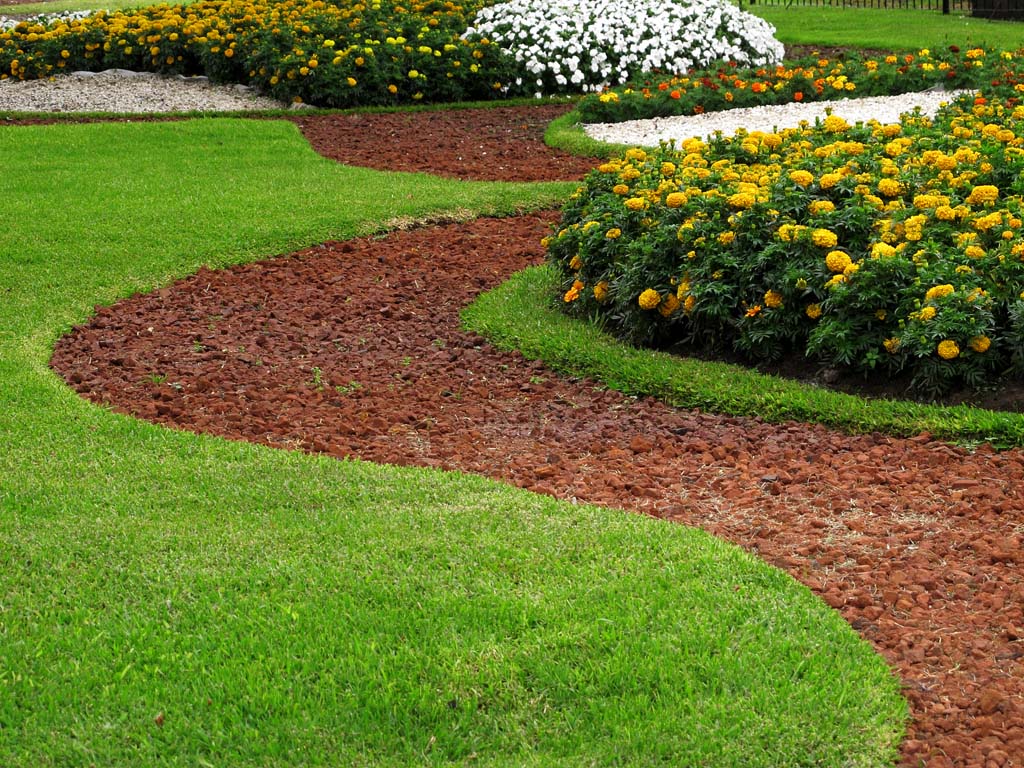
The garden floor is like the floor inside a house, but instead of being timber, tiles or carpet; the floor of a garden room might be made up of low plants, lawn, paving and mulch.
Low plants may be used in a variety of ways in a garden design, either alone, or combined with other plants. Some of the ways low plants may be used are:
-
As a lawn substitute. Create a similar visual appearance to a lawn with any type of creeper or low spreading shrub. In shaded areas or poor soils, a lawn substitute may provide a more successful cover than a struggling grass lawn. Lawn substitutes can have both advantages and disadvantages over a lawn. You may not be able to play a game of football on a field of coastal juniper or creeping rosemary (for instance), but you don’t need to mow these things either.
-
Mass planting of a single variety (e.g. 100 sq. metres covered by Ivy) can create a uniform affect that ties a garden together, and is relatively easy to maintain.
-
Mass planting of different but compatible varieties can create different affects across the seasons (e.g. a meadow of ornamental grasses planted with daffodil bulbs creates a carpet of yellow flowers in late winter or spring and a soft blanket of dine foliage that ripples in the wind at other times).
-
A two tier planting of shade loving bulbs below tall trees (i.e. No middle tier) can allow low growing plants to create a greater visual impact than what is achieved with a more traditional three tier planting.
-
Low plants in pots, tubs, raised bed or hanging baskets (e.g. The traditional way to create a wall of foliage is to grow a medium size plant from the ground upwards; but an equally effective way is to suspend a creeping plant from a hanging basket or raised planter, and let it grow down).
The Garden Walls
Components such as hedges, clumps of shrubs, fences and walls are all like the walls of a house. In the same way that walls divide an interior into a series of rooms; these things can divide a garden intro a series of garden rooms.
Breaking a garden up into a lot of small areas can both create interest, and make a garden seem a lot bigger than it really is.
A garden which cannot all be seen from the one place will always seem bigger, as you move from one enclosed space to the next. The same area that is just one large open space will never feel like it is such a large garden.
Generally fences are less expensive than walls, but also thinner and perhaps less permanent than garden walls made from stone or brick. Nevertheless, a well built fence, made from quality materials and maintained properly will last 50 years or more.
The most common types of fence are solid, made from vertical timbers or metal sheets. Other, perhaps more attractive styles include spaced horizontal timbers, pickets or trellis. Walls, fences and other types of barriers are used in gardens for several reasons:
-
To define an area creating the boundary of one section of a garden, separating it from other sections of the same garden
-
To screen an undesirable view (i.e. To hide something you don't want to be looked at).
-
To provide a windbreak
-
To provide privacy (i.e. Stop other people looking into that part of the garden).
-
To provide some barrier to noise (though this is minimal)
-
As a barrier to people, particularly children, and animals, either to keep them in or out of an area.
Where this Course Can Lead You
Graduates from this course will have an enhanced understanding of landscaping, and a greater awareness of the possibilities for creating a garden.
- Anyone who already works in landscaping or gardening, will improve their career or business prospects.
- Amateur gardeners will see new possibilities for their own garden.
- People who work in landscape supplies or hardware will expand their understanding of at least some of the products they deal with.
- Others may find enhanced opportunities for employment or business in something totally new to them.
Enrol using the automated procedure on this site or contact us via phone or email to ask questions and enrol with a real person.
You can enrol at anytime and start the course when you are ready. Enrolments are accepted all year - students can commence study at any time. All study is self paced and ACS does not set assignment deadlines.
Please note that if a student is being assisted by someone else (e.g. an employer or government subsidy), the body offering the assistance may set deadlines. Students in such situations are advised to check with their sponsor prior to enrolling. The nominal duration of a course is approximately how long a course takes to complete. A course with a nominal duration of 100 hours is expected to take roughly 100 hours of study time to complete. However, this will vary from student to student. Short courses (eg. 100 hrs duration) should be completed within 12 months of enrolment. Certificates, Advanced Certificates and Awards (eg. over 500 hours duration) would normally be completed within 3 -5 years of enrolment. Additional fees may apply if a student requires an extended period to complete.
If a student cannot submit their assignments for 6 months to ACS, they should advise the school to avoid cancellation of their student
registration. Recommencement fees may apply.
Simply click on the ENROL OPTIONS button at the top of this screen and follow the prompts.
You can see the course price at the top of this page. Click 'enrolment options' to see any payment options available.
You can pay by Credit Card, PayPal, Afterpay or bank transfer.
Yes! We have payment plans for most courses. Click 'enrolment options' to see the available payment plans.
We also have Afterpay that will allow you to pay for your course or payment plans in four instalments (if you are in Australia).
There are no entry requirements that you need to meet to enrol in our courses, our courses are for everyone.
If you are under 18, we need written permission from your parent/ guardian for your enrolment to continue, we can arrange that after you have enrolled.
You don’t need to purchase any additional resources to complete our courses.
What do I need to know before I enrol?
We aim to teach you the essentials without you having to purchase any specific computer program.
We recommend that you have access to a word processing program, such as Microsoft Word or Google Docs, so that you can easily complete and submit your assignments.
You sure can. We are here to help you learn whatever your abilities.
Yes, if you are enrolling in a Certificate or Advanced Certificate, you might be eligible for credits if you have evidence of your previous studies or relevant experience. More information is here.
We recommend that you are able to browse websites, send emails and conduct online research. You will need to be able to type and submit your assignments.
If you have limited computer skills, we can make special arrangements for you.
This is possible, it depends on the institution. We recommend that if you would like to use our courses that you contact the institution first. Our Course Handbook is a good resource for this.
Our courses are written in English and we only have English speaking academic staff. If you can read and complete your assignments in English, our courses are ideal for you.
Our courses are designed to build knowledge, hands on skills and industry connections to help prepare you to work in the area, running your own business, professional development or as a base for further study.
This course has been designed to cover the fundamentals of the topic. It will take around 100 hours to complete, which includes your course reading, assignment work, research, practical tasks, watching videos and anything else that is contained in the course. Our short courses are a great way to do some professional development or to learn a new skill.
It’s up to you. The study hours listed in the course are a rough guide, however if you were to study a short course (100 hours) at 10 hours per week, you could finish the course in 10 weeks (just an example). Our courses are self-paced, so you can work through the courses in your own time. We recommend that you wait for your tutor to mark and return your assignment before your start your next one, so you get the benefits of their feedback.
The course consists of course notes, videos, set tasks for your practical work, online quizzes, an assignment for each lesson (that you receive feedback from your tutor from) and ends in an exam (which is optional, if would like to receive the formal award at the end), using our custom built Learning Management System - Login.Training.
Our courses are designed for adults to gain professional development and skills to further their careers and start businesses.
Our custom online learning portal allows you to conduct your learning online. There may be practical tasks that you can do offline. You have the option of downloading your course notes or print them to read later.
There is also the option to pay an additional fee for printed course notes and or USB (availability limited to location and deliverability).
Yes, if you don’t have access to the internet, you can receive the course as paper notes or on a USB stick for an additional fee. We can also make alternative arrangements for you to send your assignments to us.
We offer printed notes for an additional fee. Also, you can request your course notes on a USB stick for an additional fee.
Yes, your tutor is here to help you. Simply post any questions you have in your login.training portal or contact the office and we can pass on a message to your tutor.
We are more learning focussed, rather than assessment focussed. You have online quizzes to test your learning, written assignments and can complete an exam at the end of the course (if you want to receive your certificate). You will not receive a pass/ fail on your course work. If you need to add more details on your assignment, we will ask you to resubmit and direct you where you need to focus. If you need help, you can ask your tutor for advice in the student room.
Each module (short course) is completed with one exam.
Exams are optional, however you must sit an exam if you would like to receive a formal award. You will need to find someone who can supervise that you are sitting the exams under exams conditions. There is an additional cost of $60 incl. GST for each exam.
More information is here
There are practical components built into the course that have been designed to be achieved by anyone, anywhere. If you are unable to complete a task for any reason, you can ask your tutor for an alternative.
When you complete the course work and the exam and you will be able receive your course certificate- a Statement of Attainment. Otherwise, you can receive a Letter of Completion.
You can bundle the short courses to create your own customised learning bundle, Certificates or Advanced Certificates. More information is on this page.
Yes, our courses are built to be applicable for people living anywhere in any situation. We provide the fundamentals, and each student can apply their own unique flair for their own interests, region and circumstances with the one-on-one guidance of a tutor. There is also a bit of student directed research involved.
Employers value candidates with industry skills, knowledge, practical skills and formal learning. Our courses arm you with all of these things to help prepare you for a job or start your own business. The longer you study the more you will learn.
ACS has an arrangement with OAMPS (formerly AMP) who can arrange Professional Indemnity from Australian and New Zealand graduates across all disciplines. Ph: 1800 222 012 or email acs@oamps.com.au.
Who are ACS Distance Education?
ACS Distance Education have been educating people for over 40 years.
We are established and safe- we have been in education for over 40 years.
We are focused on developing innovative courses that are relevant to you now and what you will need to know in the future.
We are focused on helping you learn and make the most of your experience.
You can enrol at any time, you can work on your course when it suits you and at your own pace.
We are connected to many industry bodies and our staff participate in continuous improvement and learning activities to ensure that we are ahead of what learning is needed for the future.
Our courses are not accredited by the Australian Government. However many of our courses are recognised and held in high regard by many industry bodies.
Our courses are written by our staff, who all have many years experience and have qualifications in their speciality area. We have lots of academic staff who write and update our courses regularly.
How do I enrol my staff/ sponsored students?
Yes, you can do a request for a bulk enrolment and request an invoice on our Invoice Request Form
We can prepare an invoice, quote or proforma invoice. Simply complete your details on our Invoice Request form
We can arrange bulk discounts for your course enrolment, please get in touch with us to discuss your needs.
Yes, we have many students who are in locked facilities, such as prisons or hospitals. We can cater by also offering paper notes at an additional cost.
What if I have any more questions or need more information?
We can assist you to find the right course for your needs. Get in touch with us via email (admin@acs.edu.au) call on +61 7 5562 1088 or complete our course advice form.
What if I change my mind?
Please get in touch with studentservices@acs.edu.au if you would like to be removed from our mail list.
If you would like ACS Distance Education to delete your information at any time (whether you are a customer or a prospective customer), please contact our privacy officer and we will process this ( admin@acs.edu.au ).
If students require a reproduction of their certificate, an electronic copy can be provided at a cost of AUD$35 incl GST. Printed copies are not available.
Course Contributors
The following academics were involved in the development and/or updating of this course.

Diana Cole
B.A. (Hons), Dip. Horticulture, BTEC Dip. Garden Design, Diploma Chartered Institute of Personnel & Development, PTLLS (Preparing to Teach in the Life Long Learning Sector), P.D.C.
In addition to the qualifications listed above, Diana holds City & Guild construction qualifications and an NPTC pesticide spraying licence (PA1/PA6). Diana runs her own landscape gardening business (Arbella Gardens). Active in many organisations including the British Trust for Conservation Volunteers.

Rosemary Davies (Horticulturist)
Leading horticultural expert in Australia.
Rosemary trained in Horticultural Applied Science at Melbourne University. Initially she worked with Agriculture Victoria as an extension officer, taught horticulture students, worked on radio with ABC radio (clocking up over 24 years as a presenter of garden talkback programs, initially the only woman presenter on gardening in Victoria) and she simultaneously developed a career as a writer.
She then studied Education and Training, teaching TAFE apprentices and developing curriculum for TAFE, before taking up an offer as a full time columnist with the Herald and Weekly Times and its magazine department after a number of years as columnist with the Age. She has worked for a number of companies in writing and publications, PR community education and management and has led several tours to Europe.
In 1999 Rosemary was BPW Bendigo Business Woman of the Year and is one of the founders and the Patron, of the Friends of the Bendigo Botanic gardens. She has completed her 6th book this year and is working on concepts for several others.
Rosemary has a B Ed, BSc Hort, Dip Advertising & Marketing

John Mason (Horticulturist)
Parks Manager, Nurseryman, Landscape Designer, Garden Writer and Consultant.
Over 40 years experience; working in Victoria, Queensland and the UK.
He is one of the most widely published garden writers in the world.

Jacinda Cole (Horticulturist)
B.Sc., Cert.Garden Design. Landscape Designer, Operations Manager, Consultant, Garden Writer.
She was operations manager for a highly reputable British Landscape firm (The Chelsea Gardener) before starting up her own landscaping firm. She spent three years working in our Gold Coast office, as a tutor and writer for Your Backyard (gardening magazine) which we produced monthly for a Sydney punlisher between 1999 and 2003. Since then, Jacinda has contributed regularly to many magazines, co authored several gardening books and is currently one of the "garden experts" writing regularly for the "green living" magazine "Home Grown".

Garden Design Part 1
This stunning full colour Garden Design ebook is full of useful tips, information and inspiration. It contains around 300 colour illustrations! It is comprised of three parts: Design, How a Garden Functions and Aesthetics (making it look good).

Garden Design Part 2
Part 2 of the Garden Design Series is an inspiring accompaniment to the first book, but works equally well in its own right. It's brimming with ideas and practical advice for designing a wide variety of different gardens. You will learn about different styles of gardens and how to create a style to suit a site or client. It contains around 300 colour photos! Written by John Mason over several decades of visiting and photographing gardens, writing, teaching and creating gardens.

Tropical Landscaping
Tropical Landscaping is a style that may be used more in tropical places, but can still be created in cooler climates. This book provides practical advice and inspiration over 8 chapters: “Garden Design”, “Components of a Tropical Garden”, “Building the Garden”, “Outdoor Living Areas”, “Pools, Ponds and Water Features”, “Lawns”. “Plants (to use), and “Caring for Plants”. 103 pages 69 colour photos

Landscaping with Australian Plants
Explore the world of Australian plants and the exciting ways in which they can bring a new depth to a landscape or garden design.
Ideal for students, landscape gardeners and gardening enthusiasts alike, this ebook is full of glorious colour pictures of Australian native plants.