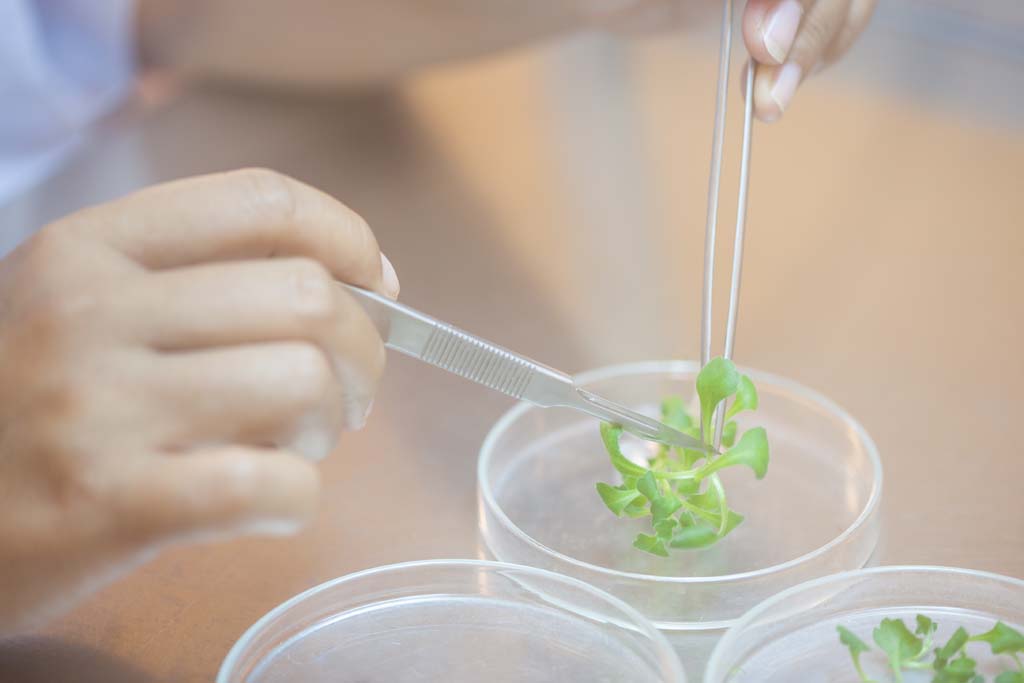
Tissue Culture
Learn to propagate plants with tissue culture. Covers the equipment, techniques and applications training you to set up and manage propagating large quantities of plants from tiny pieces of plant tissue in a laboratory.
Tissue Culture Online Course
- Learn techniques to create tens of thousands of new plants rapidly from a single parent plant.
- Discover how a profitably plant production business can be established is a tiny space - as little as one room
- Developed and delivered by a team of horticultural scientists including John Mason Dip.Hort.Sc., Gaynor Hartley Dip.Hort.Sc. Cert.Tis.Cult., Dr Lyn Morgan and Dr Kerry Claydon.
Tissue culture involves growing plants from very small sections (sometimes microscopic) in a laboratory. It is a propagation method which is being increasingly used. Tissue culture is not appropriate for many plants, but for specialist plants such as orchids, some indoor plants and many new plant varieties, it is a very popular propagation method.
Aims
- Explain the nature of plant growth processes, in the tissue culture environment.
- Determine growing media to use for tissue culture.
- Specify appropriate micropropagation procedures for different purposes.
- Explain the management of environmental control equipment used in tissue culture.
- Design a layout for a commercial tissue culture facility.
- Determine appropriate commercial applications for tissue culture.
What You Will Do
- You will learn a wide variety of things, through a combination of reading, interacting with tutors, undertaking research and practical tasks, and watching videos. Here are just some of the things you will be doing:
- Describe botanical terms which may be relevant to tissue culture.
-
Explain different physiological processes which are relevant to tissue culture, including:
- Photosynthesis
- Transpiration
- Respiration.
-
Differentiate between different types of plant tissue, including:
- Collenchyma
- Sclerenchyma
- Parenchyma
- Xylem
- Phloem
- Meristem.
- Describe the stages of plant growth during tissue culture of a specified plant.
- Explain the roles of the major and minor nutrients in tissue culture.
- Explain how five different specified plant hormones can be used in tissue culturing plants.
-
Explain the functions of different types of components of media, including:
- Nutrients
- Carbohydrates
- Vitamins
- Growth regulators
- Amino acids
- Antibiotics.
- Differentiate between appropriate applications for both liquid and solid media.
- Compare two different specified formulae for tissue culturing, formulated for two different plant genera.
-
Explain fifteen different terms relevant to micropropagation procedures, including:
- Abscission
- Aseptic
- Autoclave
- Axenic
- Bridge
- In vitro
- Deionize
- Differentiate
- Flaming
- Hardening off
- Indexing
- Pipette
- Precipitate
- Transfer
- Vitrification.
- Describe different methods of shoot proliferation used in tissue culture.
- Explain a method of sterilisation for plant tissue in an operation observed by you.
-
Distinguish between tissue culture operations which use different plant parts, including:
- Meristem
- Shoot tip
- Organ
- Cell.
- Describe the steps in producing a plant by tissue culture, observed by you in a commercial facility.
- Explain how to remove a specified plant from tissue culture, into open culture.
- Compile a resource file of twenty different suppliers of environmental control equipment.
- Determine guidelines for establishing an appropriate, controlled environment, for growing a tissue culture.
- Describe two different greenhouse management methods for acclimatising tissue cultured plants.
- Explain how knowledge of short-day, long-day and day-neutral plants is relevant to tissue culture.
- Explain methods of ensuring water used in tissue culture is pure and sterile.
- Determine the equipment needed to set up a tissue culture laboratory.
- Describe the functions of the equipment listed.
- Develop on-going maintenance guidelines for a tissue culture facility which has the range of equipment listed.
- Determine consumable materials required for the day-to-day operation of a specified tissue culture facility.
- Determine the minimum skills needed to set up a tissue culture laboratory.
- Write a job specification for a tissue culture technician, which identifies skills needed in that job.
- Draw a floor plan to scale, for a workable tissue culture laboratory, designed for a specified purpose.
- Describe commercial micropropagation methods for three different plant genera.
- Distinguish between the unique requirements for successful micropropagation of six different specified genera.
- Analyse, from research, the use of tissue culture for plant breeding.
- Determine criteria for assessing the commercial viability of using tissue culture for propagating a given plant.
- Determine the number of plants of a specified plant variety which would need to be cultured, in order to make tissue culturing of that plant commercially viable.
- Assess the commercial viability of a specified tissue culture enterprise.
Lesson Structure
There are 9 lessons in this course:
-
Introduction including a review of basic plant nutrition.
- Stages in tissue cultured plant development
- Introduction to Plant Growth Science, biochemical processes and cell biology
- Transpiration, Photosynthesis and Respiration
- Plant Parts -Stems, Leaves, Roots, Buds,Flowers and fruits
- What happens as Tissue Matures
- Types of Plant Tissue
- Methods of Shoot Induction and Proliferation
- Adventitious Roots
- Terminology
-
Plant Nutrients
- Major Elements
- Minor (Trace) Elements
- Total Salts
- How Plants Grow
- Factors Affecting Nutrient Uptake
- Nutrient Solution Preparation
- Hydroponic Nutrients
- Chelates
- Growing Media for Tissue Culture
- Water in Tissue Culture
- Chemical Analysis
-
The Laboratory
- The Tissue Culture Laboratory
- Preparation Area
- Transfer Chamber
- Culture Growing Area
- Siting a New Lab
- Equipment Requirements for a Lab
- Chemicals
-
Micropropagation Techniques
- Stock Plants -selection, planting, management
- Uses for Tissue Culture
- Problems with Tissue Culture
- Procedures
- Explants
- Sterilisation
- Nutrient Media
- Shoot Induction and Proliferation
- Rooting and Planting Out
- Stages in Plant Development
- Treating Plant Tissue with Sterilants
-
Plant Hormones
- Chemical Growth Modification
- Principles of Using Plant Hormones
- Auxins, Cytokinins, Gibberellins, Abscisic acid and Ethylene.
- Other Chemical Treatments
-
The Tissue Culture Environment
- Media Types -Filter Bridge, Agar, Liquid
- Nutrient Media Composition
- Cleanliness
- Light and Temperature
- Hormones
- Artificial Light
- Water Quality
- Water Treatments
- Carbon Dioxide Effects
- Greenhouses
- Diagnosis of Plant Disorders
-
Commercial Applications
- Understanding Genetics and Plant Breeding
- Biotechnology
- Cell Fusions
- Overcoming Pollination Incompatibility
- Pollination Biology
-
Taking Plants out of Culture
- Hardening off Plants
- Growing Rooms or Chambers
- Rockwool Applications with Micropropagation
-
Culture of Selected Species
- Begonia
- Cattleya
- Cymbidium
- Review of a range of other plants
Accreditations
Why Propagate by Tissue Culture?
Because it can allow you to multiply plants rapidly in a very small place. One plant can be turned into many thousands of plants quickly; and if you have a new cultivar; this may mean that you can get it into the market place in less than a year. If traditional propagating techniques were used, the new cultivar may have required many years of propagating before a sufficient number of new plants were available to make a new product launch viable.
If you cannot get enough cuttings, tissue culture may be the answer.
What is the down side of Tissue Culture?
You need more technical expertise; a "hospital" clean environment; and sophisticated equipment to carry out tissue culture.
Plants need to be hardened off slowly under high shade and high humidity (misting) conditions then gradually eased out into normal conditions.
Even after planting out or potting up a tissue cultured plant, you can sometimes get:
- Abnormal or no root growth.
- Plants may be prone to dry out quickly.
- Reduced photosynthetic activity of the propagation was done in a sugar enriched environment.
- Sometimes there is an induced dormancy.
Only a small proportion of plant species can be cultured well enough to be effectively propagated. The time and expense in developing the required technology may not be worthwhile for minor species. Even when it has been developed scientifically for a particular species, it is often not taken up commercially.
Compared with a conventional propagating bench, a tissue culture laboratory requires a large capital investment with correspondingly higher running costs. Labour is the largest single item of expenditure.
Despite the negatives, tissue culture is a significant and important technique that is widely used in the nursery industry. For the right situation, and the right plants; it is sometimes the best way to grow new plants.
What Should You Study?
Let us help you make the Best Decision for You!
- Contact us and tell us about your passions and ambitions.
- Let us understand your situation so we can advise you properly.
- Then make a better unformed decision about what to study.
Enrol using the automated procedure on this site or contact us via phone or email to ask questions and enrol with a real person.
You can enrol at anytime and start the course when you are ready. Enrolments are accepted all year - students can commence study at any time. All study is self paced and ACS does not set assignment deadlines.
Please note that if a student is being assisted by someone else (e.g. an employer or government subsidy), the body offering the assistance may set deadlines. Students in such situations are advised to check with their sponsor prior to enrolling. The nominal duration of a course is approximately how long a course takes to complete. A course with a nominal duration of 100 hours is expected to take roughly 100 hours of study time to complete. However, this will vary from student to student. Short courses (eg. 100 hrs duration) should be completed within 12 months of enrolment. Certificates, Advanced Certificates and Awards (eg. over 500 hours duration) would normally be completed within 3 -5 years of enrolment. Additional fees may apply if a student requires an extended period to complete.
If a student cannot submit their assignments for 6 months to ACS, they should advise the school to avoid cancellation of their student
registration. Recommencement fees may apply.
Simply click on the ENROL OPTIONS button at the top of this screen and follow the prompts.
You can see the course price at the top of this page. Click 'enrolment options' to see any payment options available.
You can pay by Credit Card, PayPal, Afterpay or bank transfer.
Yes! We have payment plans for most courses. Click 'enrolment options' to see the available payment plans.
We also have Afterpay that will allow you to pay for your course or payment plans in four instalments (if you are in Australia).
There are no entry requirements that you need to meet to enrol in our courses, our courses are for everyone.
If you are under 18, we need written permission from your parent/ guardian for your enrolment to continue, we can arrange that after you have enrolled.
You don’t need to purchase any additional resources to complete our courses.
What do I need to know before I enrol?
We aim to teach you the essentials without you having to purchase any specific computer program.
We recommend that you have access to a word processing program, such as Microsoft Word or Google Docs, so that you can easily complete and submit your assignments.
You sure can. We are here to help you learn whatever your abilities.
Yes, if you are enrolling in a Certificate or Advanced Certificate, you might be eligible for credits if you have evidence of your previous studies or relevant experience. More information is here.
We recommend that you are able to browse websites, send emails and conduct online research. You will need to be able to type and submit your assignments.
If you have limited computer skills, we can make special arrangements for you.
This is possible, it depends on the institution. We recommend that if you would like to use our courses that you contact the institution first. Our Course Handbook is a good resource for this.
Our courses are written in English and we only have English speaking academic staff. If you can read and complete your assignments in English, our courses are ideal for you.
Our courses are designed to build knowledge, hands on skills and industry connections to help prepare you to work in the area, running your own business, professional development or as a base for further study.
This course has been designed to cover the fundamentals of the topic. It will take around 100 hours to complete, which includes your course reading, assignment work, research, practical tasks, watching videos and anything else that is contained in the course. Our short courses are a great way to do some professional development or to learn a new skill.
It’s up to you. The study hours listed in the course are a rough guide, however if you were to study a short course (100 hours) at 10 hours per week, you could finish the course in 10 weeks (just an example). Our courses are self-paced, so you can work through the courses in your own time. We recommend that you wait for your tutor to mark and return your assignment before your start your next one, so you get the benefits of their feedback.
The course consists of course notes, videos, set tasks for your practical work, online quizzes, an assignment for each lesson (that you receive feedback from your tutor from) and ends in an exam (which is optional, if would like to receive the formal award at the end), using our custom built Learning Management System - Login.Training.
Our courses are designed for adults to gain professional development and skills to further their careers and start businesses.
Our custom online learning portal allows you to conduct your learning online. There may be practical tasks that you can do offline. You have the option of downloading your course notes or print them to read later.
There is also the option to pay an additional fee for printed course notes and or USB (availability limited to location and deliverability).
Yes, if you don’t have access to the internet, you can receive the course as paper notes or on a USB stick for an additional fee. We can also make alternative arrangements for you to send your assignments to us.
We offer printed notes for an additional fee. Also, you can request your course notes on a USB stick for an additional fee.
Yes, your tutor is here to help you. Simply post any questions you have in your login.training portal or contact the office and we can pass on a message to your tutor.
We are more learning focussed, rather than assessment focussed. You have online quizzes to test your learning, written assignments and can complete an exam at the end of the course (if you want to receive your certificate). You will not receive a pass/ fail on your course work. If you need to add more details on your assignment, we will ask you to resubmit and direct you where you need to focus. If you need help, you can ask your tutor for advice in the student room.
Each module (short course) is completed with one exam.
Exams are optional, however you must sit an exam if you would like to receive a formal award. You will need to find someone who can supervise that you are sitting the exams under exams conditions. There is an additional cost of $60 incl. GST for each exam.
More information is here
There are practical components built into the course that have been designed to be achieved by anyone, anywhere. If you are unable to complete a task for any reason, you can ask your tutor for an alternative.
When you complete the course work and the exam and you will be able receive your course certificate- a Statement of Attainment. Otherwise, you can receive a Letter of Completion.
You can bundle the short courses to create your own customised learning bundle, Certificates or Advanced Certificates. More information is on this page.
Yes, our courses are built to be applicable for people living anywhere in any situation. We provide the fundamentals, and each student can apply their own unique flair for their own interests, region and circumstances with the one-on-one guidance of a tutor. There is also a bit of student directed research involved.
Employers value candidates with industry skills, knowledge, practical skills and formal learning. Our courses arm you with all of these things to help prepare you for a job or start your own business. The longer you study the more you will learn.
ACS has an arrangement with OAMPS (formerly AMP) who can arrange Professional Indemnity from Australian and New Zealand graduates across all disciplines. Ph: 1800 222 012 or email acs@oamps.com.au.
Who are ACS Distance Education?
ACS Distance Education have been educating people for over 40 years.
We are established and safe- we have been in education for over 40 years.
We are focused on developing innovative courses that are relevant to you now and what you will need to know in the future.
We are focused on helping you learn and make the most of your experience.
You can enrol at any time, you can work on your course when it suits you and at your own pace.
We are connected to many industry bodies and our staff participate in continuous improvement and learning activities to ensure that we are ahead of what learning is needed for the future.
Our courses are not accredited by the Australian Government. However many of our courses are recognised and held in high regard by many industry bodies.
Our courses are written by our staff, who all have many years experience and have qualifications in their speciality area. We have lots of academic staff who write and update our courses regularly.
How do I enrol my staff/ sponsored students?
Yes, you can do a request for a bulk enrolment and request an invoice on our Invoice Request Form
We can prepare an invoice, quote or proforma invoice. Simply complete your details on our Invoice Request form
We can arrange bulk discounts for your course enrolment, please get in touch with us to discuss your needs.
Yes, we have many students who are in locked facilities, such as prisons or hospitals. We can cater by also offering paper notes at an additional cost.
What if I have any more questions or need more information?
We can assist you to find the right course for your needs. Get in touch with us via email (admin@acs.edu.au) call on +61 7 5562 1088 or complete our course advice form.
What if I change my mind?
Please get in touch with studentservices@acs.edu.au if you would like to be removed from our mail list.
If you would like ACS Distance Education to delete your information at any time (whether you are a customer or a prospective customer), please contact our privacy officer and we will process this ( admin@acs.edu.au ).
If students require a reproduction of their certificate, an electronic copy can be provided at a cost of AUD$35 incl GST. Printed copies are not available.
Course Contributors
The following academics were involved in the development and/or updating of this course.

Dr. Lynette Morgan
Broad expertise in horticulture and crop production. She travels widely as a partner in Suntec Horticultural Consultants, and has clients in central America, the USA, Caribbean, South East Asia, the Middle East, Australia and New Zealand.

Marie Beermann
Marie has more than 10 years experience in horticulture and education in both Australia and Germany. Marie's qualifications include B. Sc., M. Sc. Hort., Dip. Bus., Cert. Ldscp.

John Mason (Horticulturist)
Parks Manager, Nurseryman, Landscape Designer, Garden Writer and Consultant.
Over 40 years experience; working in Victoria, Queensland and the UK.
He is one of the most widely published garden writers in the world.
Commercial Hydroponics
Learn how to grow vegetables, fruit, cut flowers, herbs and other plants hydroponically. This classic is now re-published with new images, a new layout and revised text. A must have resource for anyone who wants to grow hydroponically.

Growing Ferns
A complete guide to growing Ferns in Australia, New Zealand and beyond. A great reference for professional and amateur gardeners, and fern enthusiasts from anywhere around the world.

Orchids
A colourful guide for students, home gardeners and orchid enthusiasts. The first part deals with growing orchids, and the second covers dozens of orchid genera, and hundreds of cultivars. Explore orchids as cut flowers, container plants, indoor plants and outdoor garden plants, in both tropical and temperate climates, across the world.

Roses
There are few things as uplifting as being greeted by the sweet fragrance of roses from your own garden. If you have always wanted to grow roses, or perhaps improve an established rose garden, make sure you are armed with the right knowledge! Learn from the masters in horticulture. This wonderfully colourful ebook will teach you everything you need to know about the passion of growing roses.