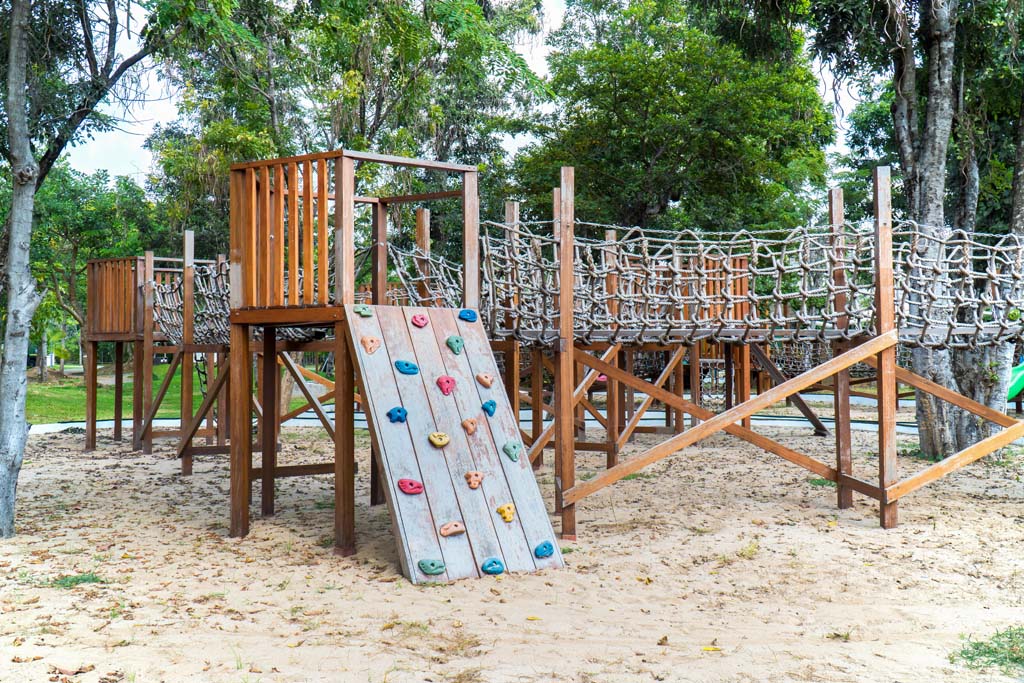
Learn to Create a Landscape that is Sympathetic to the Play Experience.

"Children learn more from play than they do from school. It is crucial to their social, physical and intellectual development. Anyone (Parent to landscaper) who develops a landscape that is to be used by children, has a responsibility to understand the full implications of what they are creating. It is critical that we enhance the play opportunities for future generations; and that involves understanding what play is, how children play, and then applying that knowledge to forming a play friendly environment" John Mason Author, the Environment of Play, former Playground Designer with Playgrounds and Recreation Assn of Vic.
“The Playground Design course shows you how to get specific ideas together to create play areas for children. There is always more than meets the eye with these wonderful areas, and experts with years of experience will outline how to go about creating them.” - Tracey Morris Dip.Hort., Cert.Hort., Cert III Organic Farming, ACS Tutor.
Aims
- Determine the procedure to plan a park development, including a playground and other facilities.
- Prepare a concept plan for a park or playground.
- Assess the design of park components, including materials and equipment used in parks and playgrounds.
- Determine appropriate design characteristics for a local or neighbourhood parks.
- Determine legal implications involved in the design of a playground.
- Design facilities to cater for movement throughout a park or playground.
- Manage appropriate community participation in development of a park or playground.
What You Will Do
- Explain how an understanding of play theory can be applied to the design of a playground.
- Explain how the concept of recreational planning may influence the design of a specified park.
- Determine factors which distinguish park design from home garden design.
- Compare different planning processes used for developing designs for public landscapes, including: advocacy planning, strategic planning and community participation.
-
Explain historical influences upon park design, in your locality, including:
- local history
- national history.
- Evaluate the functional depreciation of a specified playground over a period of at least ten years.
- Explain the significance of demographic considerations on park design, in a specific locality.
- Evaluate the designs of two different established parks, and two established playgrounds, visited by you.
- Develop a brief for a park plan, through an interview with management of a specific site.
- Collect preplanning information for a proposed park design; through surveying the site and interviewing both managers of the site, and intended users of the site.
- Develop three alternative concept plans for a proposed park development; in accordance with a real design brief, either prepared by you with a client, or obtained as a brief for a job being put to tender.
- Compare three alternative concept plans in an interview with a client, or prospective client, for a proposed park development; recording the interview session on audio tape.
- Describe the design features of four different items of outdoor furniture intended for use in parks and playgrounds.
- Compare the suitability of different barriers, including bollards, fences, plantings and walls, used in three different parks and/or playgrounds; visited and inspected by you.
- Assess the design of garden constructions inspected by you in a childrens playground.
- Compare various ground surfacing materials in terms of their application in park or playground design.
- Explain design considerations for earth forming, in a specific park and playground.
- Design a park plan for a specified site of 1,000 to 10,000 square metres, incorporating a themed play area.
- Prepare a costing for the construction of a themed play area, designed by you.
-
Compare the appropriateness of fifteen different plants for use in a playground in terms of different factors including:
- play possibilities
- hardiness
- toxicity.
- Determine appropriate design criteria for the use of water in playgrounds.
- Determine appropriate functions for neighbourhood parks.
- Determine inappropriate functions for a neighbourhood park.
- Analyse two neighbourhood parks by both; surveying users and observing users.
-
Evaluate the design of two different neighbourhood parks, visited and studied by you, against different criteria including:
- Function
- Aesthetics
- Maintenance requirement
- Environmental sympathy.
- Recommend design modifications for a surveyed neighbourhood park.
- Explain the significance of danger to the children's learning experience.
- Determine how two different specific playground designs have been influenced by concerns about legal liability.
- Conduct a legal risk analysis of a playground which has been established for more than ten years.
- Develop guidelines for minimising legal liability in playground design, for an authority responsible for a specific playground.
-
Determine design criteria for different types of trails in parks including: *Fun and fitness trails
- Environmental interpretation trails
- Cycle paths
- Linkages between parks
- Roadways.
-
Compare the construction of three different specified paths within parks with reference to:
- Durability
- Safety
- Function
- Maintenance requirements.
- Prepare a concept plan for a "specialist trail" in a park, such as; a fun and fitness trail, a cycle path or an environmental interpretation trail, following design standards in the industry.
- Determine factors which impact on the success of a park/playground development which involves community participation.
-
Analyse community attitudes to a park or playground development, which has used community participation, by either:
- survey
- discussion with local Parks Department management.
- Explain how to promote community involvement in park development in a way which will optimise the chance of success.
- Determine a procedure to involve a community in the development of a park/playground facility, on a site visited by you.
Lesson Structure
There are 8 lessons in this course:
-
Overview of Parks and Playgrounds
- Types of Playgrounds
- Big Toy Playgrounds
- Community Playgrounds
- Adventure Playgrounds
- Manipulating the Environment to provide for play
- Play Forests; bamboo, pine, eucalypt, deciduous
- Evaluating a Playground's value
- Checklist for Functional Value of a Playground
- Site Planning Process
- Planning and Design
- Insurance Considerations
- Planning Theories: comprehensive, structure, systems, advocacy
- Central Place Theory
-
Playground Philosophy
- What is Play
- Children interacting with the Environment
- Nature and Scope of Adventure Playgrounds
- Establishing an Adventure Playground
- The Adventure Play Leader
- Site Design
-
Preparing a Concept Plan
- Planning for Play; planning levels, planning participants, processes
- Stages of Planning
- Project Questionnaire
- Planning Principles
- Design Procedure Step by Step
- Minimising Costs in a Playground Development
- Catering for Disabled People
- Special Playgrounds
- Case Study Playground in a Child Care Centre
- Case Study in a Public Park
-
Materials
- Characteristics
- Comparing and Choosing Options for Construction Materials
- Barriers and Walls
- Fences
- Surfaces, paths and hard surfaced areas
- Safety Characteristics of Different Surfaces
- Construction with Wood
-
Park & Playground Structures and Materials
- Components of a Playground
- Further Design Factors
- Using Plants in Playgrounds
- Buildings and Structures; gazebos, outdoor rooms, cubbies, shelters, sheds, belvederes, pergolas etc
- Planting around a Building
- Siting of Buildings
- Building Floors
- Deciding what building to use
- Earth Forming, Shaping and Earthmoving Equipment
- Checklist for Construction Issues to Watch Out For
-
Local and Neighbourhood Parks
- Considering Local Needs
- Fun and Fitness Trails
- Skateboarding Facilities
- Multi Purpose Courts
- Park Interpretive and Environmental Facilities
- BMX Facilities
- Motor Vehicles
- Case Study: Community Play Park
-
Community Participation In Park Development
- History, Attitudes, Philosophy
- Making a Working Bee Successful
- Community Gardens
- Special Assignment.
Accreditations
WHAT TYPE OF PLAYGROUND IS APPROPRIATE?
There are many different ways of classifying playgrounds, and below is just one. The following classification will have many areas of overlap; but it's a useful way of seeing the diversity of options that you may learn about in this course.
Parts of each of these types of playground can be seen in each other; never the less, this classification may help us better understand the alternatives open to us.
BIG TOY PLAYGROUNDS
Here the playground is essentially a structure, or piece of equipment which offers some play possibility. Like smaller children's toys, there are good items of playground equipment, and poor. Like smaller toys their value is perhaps best judged on:‑
- The variety of play possibilities offered.
- The safety of the item.
- The quality of workmanship (is it solid?)
Playgrounds of this type are achieved one of two ways, both with advantages and disadvantages:‑
- Purchasing prefabricated equipment‑workmanship is usually excellent, safety is normally good, variety of play possibility is sometimes limited, cost is usually high.
- Building from recycled materials‑workmanship, safety, and play possibilities can vary enormously depending usually on who has been involved with it's building. Cost however, is usually relatively low.
ENVIRONMENTAL PLAYGROUNDS
The emphasis here is on creating an environment which is conducive to play. This might or might not include equipment. It might simply be trees, surfacing materials and contour variations.
To develop this type of area well you need a very good understanding of both the nature of play as well as environmental design and construction.
This is an environment to encourage play with places to hide, hidden corners to explore, things to climb, and shade for protection.
COMMUNITY PLAYGROUNDS
The most important thing in this type of playground is the involvement of the community. The success or failure of this type of playground is dependent on the attitude which the community holds far more than on the physical nature of what has been built.
ADVENTURE (Free Play) PLAYGROUNDS
Free play is the essence of this type of playground.
Here the child is in charge of their own environment and activity.
They can change their environment as they wish; dig a hole, build a cubby etc.
CONSIDER:
Many things influence and restrict the type of playground which can/should be provided in any place. Some are:
- How frequently is it used by the same children?
- What is the age of the users?
- Is it supervised or not?
- What other facilities are existing in the area?
- What resources are available? (money, expertise, land etc.).
CHILDREN'S PLAY IS IMPORTANT
Children’s play is actually quite serious. In fact, it is perhaps the most important way that children learn.
If play is constructive and full of variety, children will learn more and faster, so the best play equipment is that which supports and encourages a wide variety of different activities.
The Role of Play
Babies and young children play beside each other, rather than with each other. Early play helps children develop better control over their movements, and raises awareness and understanding of their physical surroundings.
As a toddler masters the physical world, their attention gradually turns to more intangible things and by the age of five, most children are more interested in interacting with other children. Through interactive play, they develop communication and social skills.
PLAY EQUIPMENT FOR DIFFERENT AGES
A baby will often respond to things that happen without their physical input (e.g. noise from a music box or a mobile hanging over the cradle). Try installing mobiles, wind chimes or sculptures with moving parts in your garden to stimulate them.
A toddler likes variety. They tend to play in different places, with different stimuli.
Preschool children really like to get involved. They like to manipulate their environment, to build things, or change things around. While a two-year-old may be enthralled by small building blocks, an older child will want to make bigger and more significant changes to their environment (e.g. doors or windows that open and close or sand that can be shaped into any form).
Children over the age of five need a greater physical challenge and need things they can do in pairs or groups. If something is not meant to be used by several children they will very often find a way to manipulate it for use by more than one at a time e.g. a slide meant for one child is likely to be used by several children sliding down together.
What to Look For in Play Equipment for Preschool Children
- Different textured surfaces (e.g. rough and smooth).
- Variety of materials (e.g. rubber, wood, plastic, metal).
- A variety of different play spots – inside a cubby, in front of the cubby and behind the cubby all feel like different places to the child.
- Things that can be moved.
- Things that encourage the greatest variety of movements in the child. If they can climb it - it is good, but if they can climb, slide and swing, it is much better.
What to Look For in Play Equipment for School Aged Children
- Their bodies are physically bigger, so the equipment needs to be sturdier and bigger.
- Their minds are more complex and informed, so if the equipment isn’t more challenging and flexible, they will probably get bored and simply not use it.
- Consider how it enhances social play – provide private places where children can sit, talk, or play pretend games (role-play) together.
Play equipment should be seen as only one component in creating a total play environment. Choose equipment with an awareness of how it is going to fit into and enhance the area you are trying to create.
Safety
- Above all, there must be a soft surface below anything which a child can fall from. (Note: A fall of just a metre onto concrete or hard earth can result in a bone fracture).
- Check for and avoid sharp edges and protruding objects that could catch clothing or be tripped on
- Attend to excessively slippery surfaces.
- Make sure the dimensions are in scale to the size of the child who will use the equipment. If a small child needs to reach too far to grab something, they are more likely to slip and fall.
- The parent should be able to see/supervise the child – ideally without the child realising they are being observed. This is particularly important for preschool children but older children can be afforded more hiding places.
Recommended Play Surfaces
- Suitable surfaces include mulches composed of bark or wood shavings (at least 20cm thick).
- Lawn should be thick, dense and cut long (poor quality grass cut very short can be almost as bad as bare earth).
- Rubber tiles or matting are ideal where practicable (safety tiles can be purchased from play equipment companies and fixed to hard surfaces like concrete).
CHILD-PROOFING A GARDEN
A safe, stimulating back garden will provide children with hours of enjoyment and, just as importantly, give you peace of mind.
A childproof garden has the following features:
- Safety fencing with secured gates.
- Soft, clean playing surfaces - a vigorous, thick and well-mown lawn is ideal. Keep the lawn free of weeds, sticks, prickly seed pods and other debris.
- Paths – constructed from smooth non-slip materials e.g. brick pavers.
- Garden bed and path edges - avoid sharp, protruding edges or edges that may be a tripping hazard.
- Shade – from verandas, shade wings, portable sun shelters, trees.
- Play area within sight of the house (for young children).
- Lockable garden shed - place chemicals, sharp tools and spray equipment on high shelves out of children's reach. Do not store chemicals or oils in old soft drink or juice containers.
Designing the Garden for Children
The key to designing a garden for children is to incorporate safety features such as childproof fencing, shady play areas and non-slip surfaces, alongside other features that will engage their attention and keep them out of mischief.
1) Lawns
Leave as large an area as possible for lawns. There is nothing that beats a lawn as an area where an overactive child can burn off excess energy. In the early years, it may even be worthwhile compromising on garden beds in favour of lawns.
2) Separate Play Area
Keeping the children's play area separate from the adult areas will minimise conflicts. Depending on the child’s age, the area could include play equipment, pet cages (for guinea pigs, birds, etc), a cubby, and their own garden bed. Ideally their area should include at least one medium to large tree for climbing, shade, or constructing a tree house. Make sure you are always present when young children are climbing.
3) Water Safety
Poolside fencing is essential. Even if your children can swim, a fence is necessary to protect the children of neighbours and visitors. A steel fence with a childproof gate is the safest choice – check your council regulations.
Small wading pools must be emptied immediately after use. Don’t leave them lying around – they could fill with rainwater and attract the attention of toddlers.
Garden ponds should be covered with wire mesh until children can be trusted with water. The mesh can be set at just below the water line so that it doesn’t look too obtrusive. Alternatively, fill the pond with attractive pebbles until the children are older.
Plants to Avoid
- Poisonous plants - e.g. Caladium, Dieffenbachia, Castor Oil Plant, Datura, Oleander, Poinsettia, Kangaroo Berry (Solanums) and Hellebores.
- Plants that cause allergic reactions - e.g. Grevillea, Rhus, Solanum sp.
- Plants with sharp or prickly, thorny leaves, seeds, stems or fruit - e.g. Agave, Pampas Grass, Pyracantha, Mahonia, and Roses.
PLAY EQUIPMENT
1) Sand Pit
This should have sturdy but smooth edges. A secure cover will keep the rain out and prevent leaves, sticks, etc from blowing in. It also prevents animals from contaminating the sand.
Portable plastic sandpits are inexpensive and easy to clean. They can also be used as paddle pools in warmer weather. A home-made sandpit has the advantage that you can build it to any size or shape - a large pit will allow two or more children to play together safely, using larger toys. Another bonus is that timber edges can be used as seating.
2) Cubbies or Wendy Houses
Choose or build a well-constructed, well-finished cubby house. Don’t make it too small or dark, otherwise it won’t get much use. A weatherproof cubby with a clean, dry floor will also encourage use.
3) Swings and Climbing Frames
Of all the play areas in the backyard, swing sets and climbing frames are the most likely source of accidents, so choose sturdy, safe equipment and soft surfacing to minimise the risks.
A set bought from a reputable toy or hardware shop will most likely conform with safety regulations. If you build your own swing or purchase a timber frame make sure the edges are rounded and smooth, and that all moving parts are securely attached. Concrete footings may be needed to secure the set in soft ground.
Check the equipment at least once a month to make sure it is in safe working order:
- Nuts and bolts may need tightening.
- Plastic components may become brittle or cracked and may need replacing.
- Check for splinters on timber.
- Check for corrosion, cracking or distortion on metal components.
- Replace frayed ropes immediately.
Surfaces for Play Equipment
Never place the equipment on paving or asphalt. Soft lawn, fine sand or rubber playground matting are ideal surfaces. If loose fill materials such as sand or bark chips are used, rake and replace them as needed to prevent compaction and dispersion.
WHO IS THIS COURSE FOR?
- People who plan, design or build playgrounds - landscapers, engineers, architects, construction workers, etc
- People who manage the use or maintenance of playgrounds safety officers and parks staff to teachers, play-leaders and child care staff
- People who manufacture or sell play equipment
- Parents, teachers, developmental psychologists, play therapists, politicians or anyone else concerned with play provision
- Play consultants, researchers, academics, therapists - anyone with a passion and appreciation of play and it's significance to mankind
Enrol using the automated procedure on this site or contact us via phone or email to ask questions and enrol with a real person.
You can enrol at anytime and start the course when you are ready. Enrolments are accepted all year - students can commence study at any time. All study is self paced and ACS does not set assignment deadlines.
Please note that if a student is being assisted by someone else (e.g. an employer or government subsidy), the body offering the assistance may set deadlines. Students in such situations are advised to check with their sponsor prior to enrolling. The nominal duration of a course is approximately how long a course takes to complete. A course with a nominal duration of 100 hours is expected to take roughly 100 hours of study time to complete. However, this will vary from student to student. Short courses (eg. 100 hrs duration) should be completed within 12 months of enrolment. Certificates, Advanced Certificates and Awards (eg. over 500 hours duration) would normally be completed within 3 -5 years of enrolment. Additional fees may apply if a student requires an extended period to complete.
If a student cannot submit their assignments for 6 months to ACS, they should advise the school to avoid cancellation of their student
registration. Recommencement fees may apply.
Simply click on the ENROL OPTIONS button at the top of this screen and follow the prompts.
You can see the course price at the top of this page. Click 'enrolment options' to see any payment options available.
You can pay by Credit Card, PayPal, Afterpay or bank transfer.
Yes! We have payment plans for most courses. Click 'enrolment options' to see the available payment plans.
We also have Afterpay that will allow you to pay for your course or payment plans in four instalments (if you are in Australia).
There are no entry requirements that you need to meet to enrol in our courses, our courses are for everyone.
If you are under 18, we need written permission from your parent/ guardian for your enrolment to continue, we can arrange that after you have enrolled.
You don’t need to purchase any additional resources to complete our courses.
What do I need to know before I enrol?
We aim to teach you the essentials without you having to purchase any specific computer program.
We recommend that you have access to a word processing program, such as Microsoft Word or Google Docs, so that you can easily complete and submit your assignments.
You sure can. We are here to help you learn whatever your abilities.
Yes, if you are enrolling in a Certificate or Advanced Certificate, you might be eligible for credits if you have evidence of your previous studies or relevant experience. More information is here.
We recommend that you are able to browse websites, send emails and conduct online research. You will need to be able to type and submit your assignments.
If you have limited computer skills, we can make special arrangements for you.
This is possible, it depends on the institution. We recommend that if you would like to use our courses that you contact the institution first. Our Course Handbook is a good resource for this.
Our courses are written in English and we only have English speaking academic staff. If you can read and complete your assignments in English, our courses are ideal for you.
Our courses are designed to build knowledge, hands on skills and industry connections to help prepare you to work in the area, running your own business, professional development or as a base for further study.
This course has been designed to cover the fundamentals of the topic. It will take around 100 hours to complete, which includes your course reading, assignment work, research, practical tasks, watching videos and anything else that is contained in the course. Our short courses are a great way to do some professional development or to learn a new skill.
It’s up to you. The study hours listed in the course are a rough guide, however if you were to study a short course (100 hours) at 10 hours per week, you could finish the course in 10 weeks (just an example). Our courses are self-paced, so you can work through the courses in your own time. We recommend that you wait for your tutor to mark and return your assignment before your start your next one, so you get the benefits of their feedback.
The course consists of course notes, videos, set tasks for your practical work, online quizzes, an assignment for each lesson (that you receive feedback from your tutor from) and ends in an exam (which is optional, if would like to receive the formal award at the end), using our custom built Learning Management System - Login.Training.
Our courses are designed for adults to gain professional development and skills to further their careers and start businesses.
Our custom online learning portal allows you to conduct your learning online. There may be practical tasks that you can do offline. You have the option of downloading your course notes or print them to read later.
There is also the option to pay an additional fee for printed course notes and or USB (availability limited to location and deliverability).
Yes, if you don’t have access to the internet, you can receive the course as paper notes or on a USB stick for an additional fee. We can also make alternative arrangements for you to send your assignments to us.
We offer printed notes for an additional fee. Also, you can request your course notes on a USB stick for an additional fee.
Yes, your tutor is here to help you. Simply post any questions you have in your login.training portal or contact the office and we can pass on a message to your tutor.
We are more learning focussed, rather than assessment focussed. You have online quizzes to test your learning, written assignments and can complete an exam at the end of the course (if you want to receive your certificate). You will not receive a pass/ fail on your course work. If you need to add more details on your assignment, we will ask you to resubmit and direct you where you need to focus. If you need help, you can ask your tutor for advice in the student room.
Each module (short course) is completed with one exam.
Exams are optional, however you must sit an exam if you would like to receive a formal award. You will need to find someone who can supervise that you are sitting the exams under exams conditions. There is an additional cost of $60 incl. GST for each exam.
More information is here
There are practical components built into the course that have been designed to be achieved by anyone, anywhere. If you are unable to complete a task for any reason, you can ask your tutor for an alternative.
When you complete the course work and the exam and you will be able receive your course certificate- a Statement of Attainment. Otherwise, you can receive a Letter of Completion.
You can bundle the short courses to create your own customised learning bundle, Certificates or Advanced Certificates. More information is on this page.
Yes, our courses are built to be applicable for people living anywhere in any situation. We provide the fundamentals, and each student can apply their own unique flair for their own interests, region and circumstances with the one-on-one guidance of a tutor. There is also a bit of student directed research involved.
Employers value candidates with industry skills, knowledge, practical skills and formal learning. Our courses arm you with all of these things to help prepare you for a job or start your own business. The longer you study the more you will learn.
ACS has an arrangement with OAMPS (formerly AMP) who can arrange Professional Indemnity from Australian and New Zealand graduates across all disciplines. Ph: 1800 222 012 or email acs@oamps.com.au.
Who are ACS Distance Education?
ACS Distance Education have been educating people for over 40 years.
We are established and safe- we have been in education for over 40 years.
We are focused on developing innovative courses that are relevant to you now and what you will need to know in the future.
We are focused on helping you learn and make the most of your experience.
You can enrol at any time, you can work on your course when it suits you and at your own pace.
We are connected to many industry bodies and our staff participate in continuous improvement and learning activities to ensure that we are ahead of what learning is needed for the future.
Our courses are not accredited by the Australian Government. However many of our courses are recognised and held in high regard by many industry bodies.
Our courses are written by our staff, who all have many years experience and have qualifications in their speciality area. We have lots of academic staff who write and update our courses regularly.
How do I enrol my staff/ sponsored students?
Yes, you can do a request for a bulk enrolment and request an invoice on our Invoice Request Form
We can prepare an invoice, quote or proforma invoice. Simply complete your details on our Invoice Request form
We can arrange bulk discounts for your course enrolment, please get in touch with us to discuss your needs.
Yes, we have many students who are in locked facilities, such as prisons or hospitals. We can cater by also offering paper notes at an additional cost.
What if I have any more questions or need more information?
We can assist you to find the right course for your needs. Get in touch with us via email (admin@acs.edu.au) call on +61 7 5562 1088 or complete our course advice form.
What if I change my mind?
Please get in touch with studentservices@acs.edu.au if you would like to be removed from our mail list.
If you would like ACS Distance Education to delete your information at any time (whether you are a customer or a prospective customer), please contact our privacy officer and we will process this ( admin@acs.edu.au ).
If students require a reproduction of their certificate, an electronic copy can be provided at a cost of AUD$35 incl GST. Printed copies are not available.
Course Contributors
The following academics were involved in the development and/or updating of this course.

John Mason
Writer, Manager, Teacher and Businessman with over 40 years interenational experience covering Education, Publishing, Leisure Management, Education, and Horticulture. He has extensive experience both as a public servant, and as a small business owner.
John is a well respected member of many professional associations, and author of over seventy books and of over two thousand magazine articles.

Jacinda Cole
Former operations manager for highly reputable Landscape firm, The Chelsea Gardener, before starting her own firm. Jacinda has over 20 years of industry experience in Psychology, Landscaping, Publishing, Writing and Education. Jacinda has a B.Sc., Psych.Cert., M. Psych. Cert.Garden Design, MACA.

Rosemary Davies (Horticulturist)
Leading horticultural expert in Australia.
Rosemary trained in Horticultural Applied Science at Melbourne University. Initially she worked with Agriculture Victoria as an extension officer, taught horticulture students, worked on radio with ABC radio (clocking up over 24 years as a presenter of garden talkback programs, initially the only woman presenter on gardening in Victoria) and she simultaneously developed a career as a writer.
She then studied Education and Training, teaching TAFE apprentices and developing curriculum for TAFE, before taking up an offer as a full time columnist with the Herald and Weekly Times and its magazine department after a number of years as columnist with the Age. She has worked for a number of companies in writing and publications, PR community education and management and has led several tours to Europe.
In 1999 Rosemary was BPW Bendigo Business Woman of the Year and is one of the founders and the Patron, of the Friends of the Bendigo Botanic gardens. She has completed her 6th book this year and is working on concepts for several others.
Rosemary has a B Ed, BSc Hort, Dip Advertising & Marketing

Adriana Fraser (Horticulturist)
Over 30 years working in horticulture, as a gardener, propagator, landscape designer
, teacher and consultant. Adriana has spent much of her life living on large properties, developing and maintaining her own gardens, and living a semi self sufficient lifestyle. She has decades of practical experience growing her own fruit, vegetables and herbs, and making her own preserves. She is well connected with horticulture professionals across Australia, and amongst other things, for a period, looked after Australia's national collection of Thymus. Advanced Diploma in Horticulture, Advanced Certificate in Horticulture.