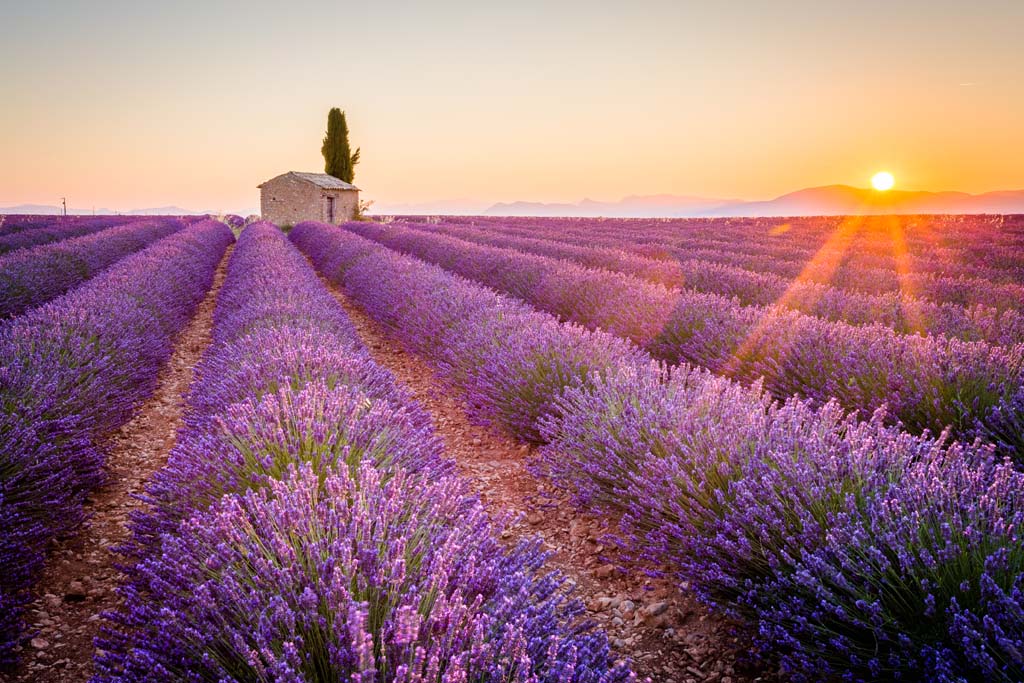
Learn to Grow, Harvest and Use Lavender
This is a course for anyone with a passion or serious interest in lavender -amateurs and professionals alike.
If you are thinking about starting a lavender farm; or even a herb nursery or other business which will be growing lavender plants or making lavender products: this is an ideal starting point. It gives you systematic approach to developing your understanding and knowledge, and as you do, an opportunity to be guided by horticultural professionals who have spent decades gathering information and experience growing and using lavender.
You may be more interested in using lavender in a landscape or breeding new cultivars. This is as good a foundation as you are likely to find anywhere, with all things to do with lavender.
Lavender is grown commercially in France, England, Spain, Italy, USA, Australia, South Africa, New Zealand and Japan. Each region growing species that are best suited to local conditions – many trials have been conducted world-wide to isolate the best species for specific local conditions.
There are a number of practical tasks students will carry out in this course. If students have problems accessing facilities or resources for practical tasks, alternative tasks can be set.
Aims
- Describe the plant naming system and classification of plants
- Discuss the nature and scope of the Lavender genus.
- Describe the nutritional requirements of the lavender species.
- Explain the cultural requirements of the lavender species.
- Explain propagating techniques specific to lavender
- Describe commercial lavender growing operations.
- Select species appropriate to the climatic and soil conditions of a chosen locality.
- Describe of a variety of lavender species and cultivars.
- Describe the production processes on a lavender farm.
- Describe various lavender products and discuss the way in which they are processed.
- Explain the processes used in the marketing of lavender products.
What You Will Do
- Prepare a collection of 20 different types of lavender in the form of pressed, dried, labelled specimens
- Compile a resource file of contacts relevant to lavender and lavender growing
- Contact a number of lavender related organisations for information on their activities in the industry
- Collect and test at least three different soil samples
- Identify and (optional) manufacture a potting mix suitable for lavender growing
- Collect information on organic and inorganic fertilisers from fertiliser companies
- Research information on machinery used in horticulture by contacting the companies that produce it
- Produce a no dig garden or an organic garden
- Manufacture a propagating mix for lavender cuttings
- Take lavender cuttings for propagation
- Contact a herb nursery to observe their operation
- Research irrigation equipment by contacting irrigation suppliers
- Cross pollinate lavender and grow the resulting seed
- Compare various types of lavender
- Harvest a number of different types of lavender
- Produce a small quantity of lavender oil
- Produce two non edible and one edible product containing lavender
- Visit a shop selling lavender products to observe marketing procedures
Lesson Structure
There are 10 lessons in this course:
-
Introduction
- Classification and identification of lavender, general characteristics of the group, contacts (ie: nurseries, seed, clubs, etc.)
-
Soils, Fertilisers and Nutrition for Lavender
- Soil structure, pH, organic matter, ameliorants and organic growing.
-
Cultural Techniques for Lavender Growing
- Pruning, water management (mulching, irrigation, drainage, etc.), planting and establishment methods, crop scheduling, no dig gardening.
-
Lavender Propagation
- Propagation from cuttings, propagation growth media, other propagation methods,
-
Commercial Alternatives
- Managing a Market Garden, standards, mulches, problems and their control, weed control without chemicals, economic outlook for herbs.
-
Plant Variety Selection and Breeding
- Breeding and selecting new varieties, lavender clone selection for essential oils in Tasmania.
-
Building Plant Knowledge
- Lavender types and other varieties, advantages and disadvantages of different varieties.
-
Harvesting, Postharvest Treatment and Storage
- Harvesting, distillation and oils, post harvest preservation of fresh herbs, drying lavender.
-
Processing and Making Lavender Products
- Lavender crafts, using herbs in cooking, selling herb products.
-
Marketing Lavender Produce
- How to market your produce, considering your market, market research, selling successfully.
Accreditations
How do you Grow Lavender?
- Full sun
- Well-drained soil
- Reasonably fertile soil
- Alkaline soil - if acid, apply lime
- They tolerate dry conditions, but grow better if watered in dry weather
- Prune hard once or twice a year to keep them in shape and increase their longevity. Cut back up to one-third of the bush after flowering. Do not prune into old wood (for most species).
What Opportunities are there?
Lavender is one of the most important herbs cultivated around the world.
Demand for high quality lavender oil is always strong; and the most pure oils can often sell at per kg prices comparable with, or higher than the price of gold.
The best oils are used in some of the most expensive perfumes and this “top end” business provides excellent opportunities for lavender farmers who can perfect their farming. Perfecting your skills at this level is easier said than done though; and will take years of hard work combined with appropriate investment capital and exceptional scientific knowledge combine with a sharp business sense.
Most people who work with lavender however will work at a level below this top end.
The lavender industry is diverse, and large. Some work in businesses that focus only, or mostly, on lavender products. Others produce or market lavender products, alongside other types of products (e.g. a candle shop that sells lavender candles along with other types of candles, or a herb nursery that supplies lavender plants along with other types of herb plants).
Create a Lavender Garden, Start a Lavender Nursery, or Produce Lavender Products.
- Plants – propagation nurseries sell rooted cuttings, plants for large scale lavender plantations, potted plants (various sized pots), trained plants (e.g. topiary standard).
- Cut flowers - dried or fresh.
- Oils – retail, wholesale; supplied to factories, crafts industries, aromatherapy, etc.
- Pharmaceuticals/ Health Industries – Massage oils, aromatherapy, components in liniment, etc.
- Cleaning - washing powders and liquids, spray on cleaners.
- Perfumery - perfumes, deodorants, air fresheners.
- Pest control – garden, veterinary, human.
- Culinary - alcoholic liqueurs, non-alcoholic drinks, baked goods.
- Crafts - scented sachets, potpourri.
WHAT YOU MIGHT ACHIEVE THROUGH STUDYING THIS COURSE
Your knowledge and understanding of lavender will increase greatly.
You will become aware of commercial career and business opportunities you may not have thought about previously.
You will understand what lavenders to grow, how to harvest the plants, and how to produce different lavender products.
This is a course that can be of great value to:
- Lavender farmers
- Herbal Product Manufacturers or suppliers
- Landscapers, gardeners, horticulturists
Enrol using the automated procedure on this site or contact us via phone or email to ask questions and enrol with a real person.
You can enrol at anytime and start the course when you are ready. Enrolments are accepted all year - students can commence study at any time. All study is self paced and ACS does not set assignment deadlines.
Please note that if a student is being assisted by someone else (e.g. an employer or government subsidy), the body offering the assistance may set deadlines. Students in such situations are advised to check with their sponsor prior to enrolling. The nominal duration of a course is approximately how long a course takes to complete. A course with a nominal duration of 100 hours is expected to take roughly 100 hours of study time to complete. However, this will vary from student to student. Short courses (eg. 100 hrs duration) should be completed within 12 months of enrolment. Certificates, Advanced Certificates and Awards (eg. over 500 hours duration) would normally be completed within 3 -5 years of enrolment. Additional fees may apply if a student requires an extended period to complete.
If a student cannot submit their assignments for 6 months to ACS, they should advise the school to avoid cancellation of their student
registration. Recommencement fees may apply.
Simply click on the ENROL OPTIONS button at the top of this screen and follow the prompts.
You can see the course price at the top of this page. Click 'enrolment options' to see any payment options available.
You can pay by Credit Card, PayPal, Afterpay or bank transfer.
Yes! We have payment plans for most courses. Click 'enrolment options' to see the available payment plans.
We also have Afterpay that will allow you to pay for your course or payment plans in four instalments (if you are in Australia).
There are no entry requirements that you need to meet to enrol in our courses, our courses are for everyone.
If you are under 18, we need written permission from your parent/ guardian for your enrolment to continue, we can arrange that after you have enrolled.
You don’t need to purchase any additional resources to complete our courses.
What do I need to know before I enrol?
We aim to teach you the essentials without you having to purchase any specific computer program.
We recommend that you have access to a word processing program, such as Microsoft Word or Google Docs, so that you can easily complete and submit your assignments.
You sure can. We are here to help you learn whatever your abilities.
Yes, if you are enrolling in a Certificate or Advanced Certificate, you might be eligible for credits if you have evidence of your previous studies or relevant experience. More information is here.
We recommend that you are able to browse websites, send emails and conduct online research. You will need to be able to type and submit your assignments.
If you have limited computer skills, we can make special arrangements for you.
This is possible, it depends on the institution. We recommend that if you would like to use our courses that you contact the institution first. Our Course Handbook is a good resource for this.
Our courses are written in English and we only have English speaking academic staff. If you can read and complete your assignments in English, our courses are ideal for you.
Our courses are designed to build knowledge, hands on skills and industry connections to help prepare you to work in the area, running your own business, professional development or as a base for further study.
This course has been designed to cover the fundamentals of the topic. It will take around 100 hours to complete, which includes your course reading, assignment work, research, practical tasks, watching videos and anything else that is contained in the course. Our short courses are a great way to do some professional development or to learn a new skill.
It’s up to you. The study hours listed in the course are a rough guide, however if you were to study a short course (100 hours) at 10 hours per week, you could finish the course in 10 weeks (just an example). Our courses are self-paced, so you can work through the courses in your own time. We recommend that you wait for your tutor to mark and return your assignment before your start your next one, so you get the benefits of their feedback.
The course consists of course notes, videos, set tasks for your practical work, online quizzes, an assignment for each lesson (that you receive feedback from your tutor from) and ends in an exam (which is optional, if would like to receive the formal award at the end), using our custom built Learning Management System - Login.Training.
Our courses are designed for adults to gain professional development and skills to further their careers and start businesses.
Our custom online learning portal allows you to conduct your learning online. There may be practical tasks that you can do offline. You have the option of downloading your course notes or print them to read later.
There is also the option to pay an additional fee for printed course notes and or USB (availability limited to location and deliverability).
Yes, if you don’t have access to the internet, you can receive the course as paper notes or on a USB stick for an additional fee. We can also make alternative arrangements for you to send your assignments to us.
We offer printed notes for an additional fee. Also, you can request your course notes on a USB stick for an additional fee.
Yes, your tutor is here to help you. Simply post any questions you have in your login.training portal or contact the office and we can pass on a message to your tutor.
We are more learning focussed, rather than assessment focussed. You have online quizzes to test your learning, written assignments and can complete an exam at the end of the course (if you want to receive your certificate). You will not receive a pass/ fail on your course work. If you need to add more details on your assignment, we will ask you to resubmit and direct you where you need to focus. If you need help, you can ask your tutor for advice in the student room.
Each module (short course) is completed with one exam.
Exams are optional, however you must sit an exam if you would like to receive a formal award. You will need to find someone who can supervise that you are sitting the exams under exams conditions. There is an additional cost of $60 incl. GST for each exam.
More information is here
There are practical components built into the course that have been designed to be achieved by anyone, anywhere. If you are unable to complete a task for any reason, you can ask your tutor for an alternative.
When you complete the course work and the exam and you will be able receive your course certificate- a Statement of Attainment. Otherwise, you can receive a Letter of Completion.
You can bundle the short courses to create your own customised learning bundle, Certificates or Advanced Certificates. More information is on this page.
Yes, our courses are built to be applicable for people living anywhere in any situation. We provide the fundamentals, and each student can apply their own unique flair for their own interests, region and circumstances with the one-on-one guidance of a tutor. There is also a bit of student directed research involved.
Employers value candidates with industry skills, knowledge, practical skills and formal learning. Our courses arm you with all of these things to help prepare you for a job or start your own business. The longer you study the more you will learn.
ACS has an arrangement with OAMPS (formerly AMP) who can arrange Professional Indemnity from Australian and New Zealand graduates across all disciplines. Ph: 1800 222 012 or email acs@oamps.com.au.
Who are ACS Distance Education?
ACS Distance Education have been educating people for over 40 years.
We are established and safe- we have been in education for over 40 years.
We are focused on developing innovative courses that are relevant to you now and what you will need to know in the future.
We are focused on helping you learn and make the most of your experience.
You can enrol at any time, you can work on your course when it suits you and at your own pace.
We are connected to many industry bodies and our staff participate in continuous improvement and learning activities to ensure that we are ahead of what learning is needed for the future.
Our courses are not accredited by the Australian Government. However many of our courses are recognised and held in high regard by many industry bodies.
Our courses are written by our staff, who all have many years experience and have qualifications in their speciality area. We have lots of academic staff who write and update our courses regularly.
How do I enrol my staff/ sponsored students?
Yes, you can do a request for a bulk enrolment and request an invoice on our Invoice Request Form
We can prepare an invoice, quote or proforma invoice. Simply complete your details on our Invoice Request form
We can arrange bulk discounts for your course enrolment, please get in touch with us to discuss your needs.
Yes, we have many students who are in locked facilities, such as prisons or hospitals. We can cater by also offering paper notes at an additional cost.
What if I have any more questions or need more information?
We can assist you to find the right course for your needs. Get in touch with us via email (admin@acs.edu.au) call on +61 7 5562 1088 or complete our course advice form.
What if I change my mind?
Please get in touch with studentservices@acs.edu.au if you would like to be removed from our mail list.
If you would like ACS Distance Education to delete your information at any time (whether you are a customer or a prospective customer), please contact our privacy officer and we will process this ( admin@acs.edu.au ).
If students require a reproduction of their certificate, an electronic copy can be provided at a cost of AUD$35 incl GST. Printed copies are not available.
Course Contributors
The following academics were involved in the development and/or updating of this course.

Maggi Brown
Maggi is regarded as an expert in organic growing throughout the UK, having worked for two decades as Education Officer at the world renowned Henry Doubleday Research Association. She has been active in education, environmental management and horticulture across the UK for more than three decades.
Some of Maggi's qualifications include RHS Cert. Hort. Cert. Ed. Member RHS Life Member Garden Organic (HDRA) .

Rosemary Davies (Horticulturist)
Leading horticultural expert in Australia.
Rosemary trained in Horticultural Applied Science at Melbourne University. Initially she worked with Agriculture Victoria as an extension officer, taught horticulture students, worked on radio with ABC radio (clocking up over 24 years as a presenter of garden talkback programs, initially the only woman presenter on gardening in Victoria) and she simultaneously developed a career as a writer.
She then studied Education and Training, teaching TAFE apprentices and developing curriculum for TAFE, before taking up an offer as a full time columnist with the Herald and Weekly Times and its magazine department after a number of years as columnist with the Age. She has worked for a number of companies in writing and publications, PR community education and management and has led several tours to Europe.
In 1999 Rosemary was BPW Bendigo Business Woman of the Year and is one of the founders and the Patron, of the Friends of the Bendigo Botanic gardens. She has completed her 6th book this year and is working on concepts for several others.
Rosemary has a B Ed, BSc Hort, Dip Advertising & Marketing

John Mason (Horticulturist)
Parks Manager, Nurseryman, Landscape Designer, Garden Writer and Consultant.
Over 40 years experience; working in Victoria, Queensland and the UK.
He is one of the most widely published garden writers in the world.

Adriana Fraser (Horticulturist)
Over 30 years working in horticulture, as a gardener, propagator, landscape designer
, teacher and consultant. Adriana has spent much of her life living on large properties, developing and maintaining her own gardens, and living a semi self sufficient lifestyle. She has decades of practical experience growing her own fruit, vegetables and herbs, and making her own preserves. She is well connected with horticulture professionals across Australia, and amongst other things, for a period, looked after Australia's national collection of Thymus. Advanced Diploma in Horticulture, Advanced Certificate in Horticulture.
Herbs
Herbs are fascinating plants, mystical and romantic. They have a rich history dating back centuries. Used by monks, apothecaries and ‘witches’ in the past, herbs are undergoing a revival in interest. They are easy to grow, scented, culinary and medicinal plants. In a formal herb garden or peppered throughout the garden, herbs rarely fail! Find out how they are used as medicines, for cooking, perfumes and more.

Scented Plants
Scented plants can be either a delight or a curse. For many people, there is nothing more pleasing than a garden filled with fragrance, but for others who suffer allergies, certain plants can make them physically ill; sometimes very seriously.

Growing & Knowing Lavender
Written by John Mason, this ebook is 117 pages of wonderfully illustrated pages that explain the different lavenders, different names and growing conditions. This ebook also looks at uses for lavender in the garden, home and even business opportunities.

Medicinal Herbs
The Medicinal Herbs ebook is a practical guide on the herbs that can be used to remedy conditions in the human body. This ebook is a fascinating read that looks into the chemicals in herbs and their effects on the body.