 Become a Carnivorous Plant Expert
For some, they are a passion, and for others they can become a part time or full time occupation. They might not appeal to everyone; but carnivorous plants often capture the imagination of people who are not necessarily interested in other types of plants.
Anyone who chooses to undertake this course is obviously interested in carnivorous plants; perhaps as an amateur collector, a commercial grower or a naturalist.
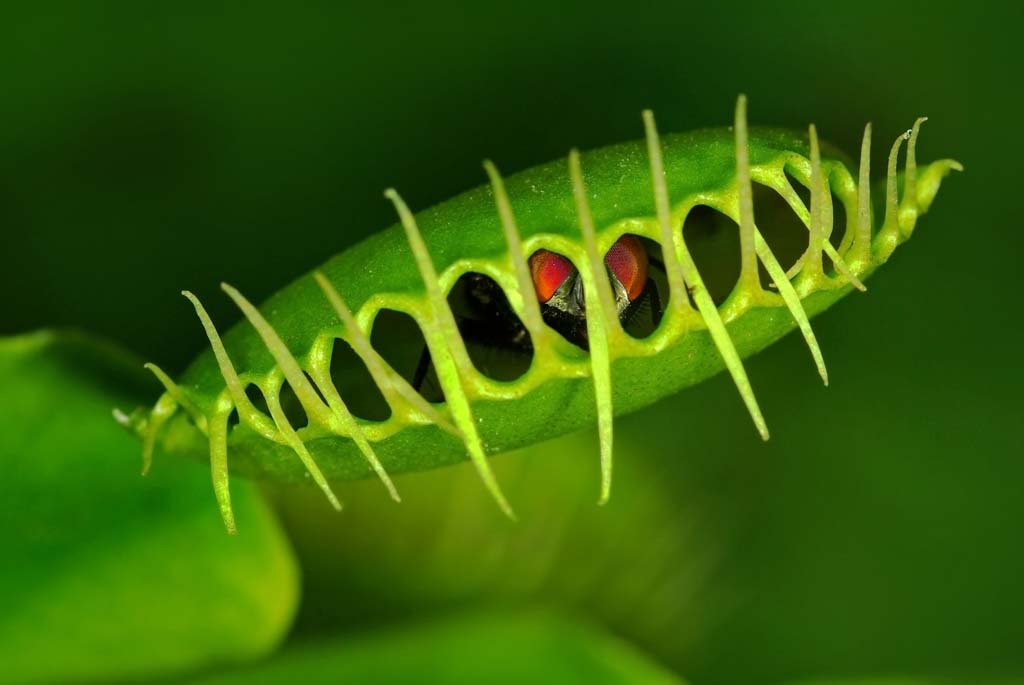
Carnivorous plants are plants that derive some or all of their nutrients by capturing and digesting small animals, such as insects.
Other terms used for carnivorous plants are a “carnivory” or a “carnivore”.
The mechanisms used to capture and digest animals are generally subtle; but not always.
Characteristics that are unique to carnivorous plants include:
- Attraction Mechanisms eg. Lures, odours, directional guides
- Trapping Mechanisms eg. Sticky secretions that hold animals like fly paper, trap door like openings to digestive chambers.
- Digestive Mechanisms eg. Secreted enzymes and absorption of digested material.
Aims
- Identify different carnivorous plants.
- Describe the cultural requirements for a range of different carnivorous plants
- Propagate a range of different carnivorous plants
- Discuss the identifying characteristics and cultural requirements of several species of both Sundews and Pitcher plants.
- Discuss the identifying characteristics and cultural requirements of several species of both Bladderworts and at least one other genus of Carnivorous plant.
- Describe the identifying characteristics and cultural requirements of several species of less commonly cultivated carnivorous plants.
- Describe the identification and culture of Australian Droseras in depth.
- Determine and describe appropriate ways of cultivating and displaying cultured carnivorous plants.
- Describe one group of carnivorous plants in depth.
Lesson Structure
There are 9 lessons in this course:
-
Introduction
- Introduction to carnivorous plants
- Recognising differences around the worls
- Plant names
- Monocotyledons and dicotyledons
- Plant families
- Classification of carnivorous plants
- Review of plant families that carnivorous plants belong to
- Types of trapping mechanisms
- Resources and networking
- Using a botanical key
- Glossary
-
Culture
- Introduction
- Planting
- Soils
- Plant nutrition
- Watering
- Plant health
- Compost making
-
Propagation and Container Growing.
- Propagating carnivorous plants
- Collecting from the wild
- Methods of propagation
- Tissue culture
- Pitcher Plants (Nepenthes) and Sundews (Drosera)
- Other important Groups.
- The Lesser Grown Varieties
- Australian Droseras
- Making the Best Use of these Plants. In containers, in the ground, as indoor plants, etc.
- Special Assignment. On one selected plant or group.
Accreditations
They are not all the same!
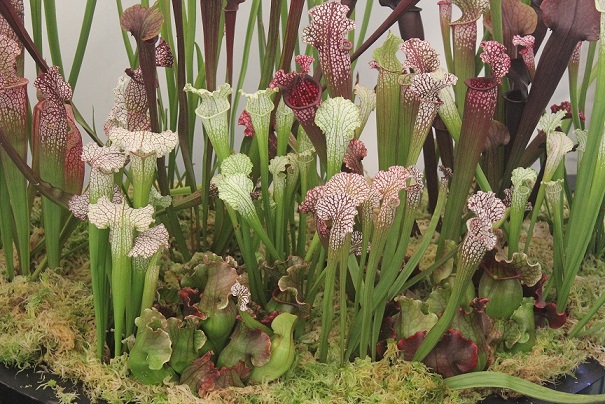
You may be surprised how much diversity there is among carnivorous plants. Many may well grow as epiphytes or bog plants in hotter and wetter places; but others can be found in colder and drier climates through many temperate parts of the world.
The shapes, colours, and ways in which they catch and digest small animals (e.g. insects) can vary a lot too.
You can grow them as pot plants, in hanging baskets; or in the ground. People from the tropics to temperate climates grow them both inside and out.
When you get to understand the many different genera and species; and the places they come from; your capacity to grow them becomes greatly improved.
How to Grow Cobra Lilies
Suggested Cultivation for the carnivorous plant, Darlingtonia californica (i.e. Cobra Lily).
- Grow in a 15 to 20cm diameter, deep container.
- Place a layer of freely draining material (crocks, stones or charcoal) at the bottom of the pot.
- Fill the pot with live sphagnum moss; then water until the moss is thoroughly moist. If the moss is dry, this can be best achieved by submersing it in water.
- Plant the cobra lily with the crown sitting right at the surface of the moss; then scatter a thin layer of living moss over the surface.
- Keep humid by covering the pot with a bell jar or plastic bag (with some ventilation (e.g. A gap at the bottom or hole in the top.
- Provide good light but not direct sunlight.
- Stand in a tray or saucer of water to provide capillary watering (i.e. Water soaks up through the moss to the surface).
- After a week or two, once the plant is growing, remove the bell jar or plastic.
- Do not repot very often. This plant does not like to have roots disturbed.
- It can tolerate cold temperatures over winter, to minus 10 degrees Celsius.
- Propagate by either taking offshoots from the rhizome; or by seed (sown and raised the same as Sarracenia).
WHY STUDY THIS COURSE?
You need to be quite passionate about carnivorous plants to undertake 100 hours of formal study into the subject; but if that describes you, this is a rare opportunity to do just that, being guided by a team of professional horticulturists and botanists who have a significant level of knowledge and expertise with these plants.
The principal John Mason assisted by other staff, are the authors of an e book on Carnivorous plants (you will receive a copy of this book as part of this course). Mr Mason has grown carnivorous plants as well as observing and photographing them across the world from Australia to England and Asia to North America.
If carnivores are your passion; perhaps it is time to take your interest to the next level through a systematic study of the subject, filling in all of the important gaps in your understanding of these plants, and setting down a foundation to grow your knowledge further in the future.
Enrol using the automated procedure on this site or contact us via phone or email to ask questions and enrol with a real person.
You can enrol at anytime and start the course when you are ready. Enrolments are accepted all year - students can commence study at any time. All study is self paced and ACS does not set assignment deadlines.
Please note that if a student is being assisted by someone else (e.g. an employer or government subsidy), the body offering the assistance may set deadlines. Students in such situations are advised to check with their sponsor prior to enrolling. The nominal duration of a course is approximately how long a course takes to complete. A course with a nominal duration of 100 hours is expected to take roughly 100 hours of study time to complete. However, this will vary from student to student. Short courses (eg. 100 hrs duration) should be completed within 12 months of enrolment. Certificates, Advanced Certificates and Awards (eg. over 500 hours duration) would normally be completed within 3 -5 years of enrolment. Additional fees may apply if a student requires an extended period to complete.
If a student cannot submit their assignments for 6 months to ACS, they should advise the school to avoid cancellation of their student
registration. Recommencement fees may apply.
Simply click on the ENROL OPTIONS button at the top of this screen and follow the prompts.
You can see the course price at the top of this page. Click 'enrolment options' to see any payment options available.
You can pay by Credit Card, PayPal, Afterpay or bank transfer.
Yes! We have payment plans for most courses. Click 'enrolment options' to see the available payment plans.
We also have Afterpay that will allow you to pay for your course or payment plans in four instalments (if you are in Australia).
There are no entry requirements that you need to meet to enrol in our courses, our courses are for everyone.
If you are under 18, we need written permission from your parent/ guardian for your enrolment to continue, we can arrange that after you have enrolled.
You don’t need to purchase any additional resources to complete our courses.
What do I need to know before I enrol?
We aim to teach you the essentials without you having to purchase any specific computer program.
We recommend that you have access to a word processing program, such as Microsoft Word or Google Docs, so that you can easily complete and submit your assignments.
You sure can. We are here to help you learn whatever your abilities.
Yes, if you are enrolling in a Certificate or Advanced Certificate, you might be eligible for credits if you have evidence of your previous studies or relevant experience. More information is here.
We recommend that you are able to browse websites, send emails and conduct online research. You will need to be able to type and submit your assignments.
If you have limited computer skills, we can make special arrangements for you.
This is possible, it depends on the institution. We recommend that if you would like to use our courses that you contact the institution first. Our Course Handbook is a good resource for this.
Our courses are written in English and we only have English speaking academic staff. If you can read and complete your assignments in English, our courses are ideal for you.
Our courses are designed to build knowledge, hands on skills and industry connections to help prepare you to work in the area, running your own business, professional development or as a base for further study.
This course has been designed to cover the fundamentals of the topic. It will take around 100 hours to complete, which includes your course reading, assignment work, research, practical tasks, watching videos and anything else that is contained in the course. Our short courses are a great way to do some professional development or to learn a new skill.
It’s up to you. The study hours listed in the course are a rough guide, however if you were to study a short course (100 hours) at 10 hours per week, you could finish the course in 10 weeks (just an example). Our courses are self-paced, so you can work through the courses in your own time. We recommend that you wait for your tutor to mark and return your assignment before your start your next one, so you get the benefits of their feedback.
The course consists of course notes, videos, set tasks for your practical work, online quizzes, an assignment for each lesson (that you receive feedback from your tutor from) and ends in an exam (which is optional, if would like to receive the formal award at the end), using our custom built Learning Management System - Login.Training.
Our courses are designed for adults to gain professional development and skills to further their careers and start businesses.
Our custom online learning portal allows you to conduct your learning online. There may be practical tasks that you can do offline. You have the option of downloading your course notes or print them to read later.
There is also the option to pay an additional fee for printed course notes and or USB (availability limited to location and deliverability).
Yes, if you don’t have access to the internet, you can receive the course as paper notes or on a USB stick for an additional fee. We can also make alternative arrangements for you to send your assignments to us.
We offer printed notes for an additional fee. Also, you can request your course notes on a USB stick for an additional fee.
Yes, your tutor is here to help you. Simply post any questions you have in your login.training portal or contact the office and we can pass on a message to your tutor.
We are more learning focussed, rather than assessment focussed. You have online quizzes to test your learning, written assignments and can complete an exam at the end of the course (if you want to receive your certificate). You will not receive a pass/ fail on your course work. If you need to add more details on your assignment, we will ask you to resubmit and direct you where you need to focus. If you need help, you can ask your tutor for advice in the student room.
Each module (short course) is completed with one exam.
Exams are optional, however you must sit an exam if you would like to receive a formal award. You will need to find someone who can supervise that you are sitting the exams under exams conditions. There is an additional cost of $60 incl. GST for each exam.
More information is here
There are practical components built into the course that have been designed to be achieved by anyone, anywhere. If you are unable to complete a task for any reason, you can ask your tutor for an alternative.
When you complete the course work and the exam and you will be able receive your course certificate- a Statement of Attainment. Otherwise, you can receive a Letter of Completion.
You can bundle the short courses to create your own customised learning bundle, Certificates or Advanced Certificates. More information is on this page.
Yes, our courses are built to be applicable for people living anywhere in any situation. We provide the fundamentals, and each student can apply their own unique flair for their own interests, region and circumstances with the one-on-one guidance of a tutor. There is also a bit of student directed research involved.
Employers value candidates with industry skills, knowledge, practical skills and formal learning. Our courses arm you with all of these things to help prepare you for a job or start your own business. The longer you study the more you will learn.
ACS has an arrangement with OAMPS (formerly AMP) who can arrange Professional Indemnity from Australian and New Zealand graduates across all disciplines. Ph: 1800 222 012 or email acs@oamps.com.au.
Who are ACS Distance Education?
ACS Distance Education have been educating people for over 40 years.
We are established and safe- we have been in education for over 40 years.
We are focused on developing innovative courses that are relevant to you now and what you will need to know in the future.
We are focused on helping you learn and make the most of your experience.
You can enrol at any time, you can work on your course when it suits you and at your own pace.
We are connected to many industry bodies and our staff participate in continuous improvement and learning activities to ensure that we are ahead of what learning is needed for the future.
Our courses are not accredited by the Australian Government. However many of our courses are recognised and held in high regard by many industry bodies.
Our courses are written by our staff, who all have many years experience and have qualifications in their speciality area. We have lots of academic staff who write and update our courses regularly.
How do I enrol my staff/ sponsored students?
Yes, you can do a request for a bulk enrolment and request an invoice on our Invoice Request Form
We can prepare an invoice, quote or proforma invoice. Simply complete your details on our Invoice Request form
We can arrange bulk discounts for your course enrolment, please get in touch with us to discuss your needs.
Yes, we have many students who are in locked facilities, such as prisons or hospitals. We can cater by also offering paper notes at an additional cost.
What if I have any more questions or need more information?
We can assist you to find the right course for your needs. Get in touch with us via email (admin@acs.edu.au) call on +61 7 5562 1088 or complete our course advice form.
What if I change my mind?
Please get in touch with studentservices@acs.edu.au if you would like to be removed from our mail list.
If you would like ACS Distance Education to delete your information at any time (whether you are a customer or a prospective customer), please contact our privacy officer and we will process this ( admin@acs.edu.au ).
If students require a reproduction of their certificate, an electronic copy can be provided at a cost of AUD$35 incl GST. Printed copies are not available.
Course Contributors
The following academics were involved in the development and/or updating of this course.

Rosemary Davies (Horticulturist)
Leading horticultural expert in Australia.
Rosemary trained in Horticultural Applied Science at Melbourne University. Initially she worked with Agriculture Victoria as an extension officer, taught horticulture students, worked on radio with ABC radio (clocking up over 24 years as a presenter of garden talkback programs, initially the only woman presenter on gardening in Victoria) and she simultaneously developed a career as a writer.
She then studied Education and Training, teaching TAFE apprentices and developing curriculum for TAFE, before taking up an offer as a full time columnist with the Herald and Weekly Times and its magazine department after a number of years as columnist with the Age. She has worked for a number of companies in writing and publications, PR community education and management and has led several tours to Europe.
In 1999 Rosemary was BPW Bendigo Business Woman of the Year and is one of the founders and the Patron, of the Friends of the Bendigo Botanic gardens. She has completed her 6th book this year and is working on concepts for several others.
Rosemary has a B Ed, BSc Hort, Dip Advertising & Marketing

Yvonne Sharpe
RHS Cert.Hort, Dip.Hort, M.Hort, Cert.Ed., Dip.Mgt. Over 30 years experience in business, education, management and horticulture. Former department head at a UK government vocational college. Yvonne has traveled widely within and beyond Europe, and has worked in many areas of horticulture from garden centres to horticultural therapy. She has served on industry committees and been actively involved with amateur garden clubs for decades.

John Mason (Horticulturist)
Parks Manager, Nurseryman, Landscape Designer, Garden Writer and Consultant.
Over 40 years experience; working in Victoria, Queensland and the UK.
He is one of the most widely published garden writers in the world.

Growing Ferns
A complete guide to growing Ferns in Australia, New Zealand and beyond. A great reference for professional and amateur gardeners, and fern enthusiasts from anywhere around the world.

Orchids
A colourful guide for students, home gardeners and orchid enthusiasts. The first part deals with growing orchids, and the second covers dozens of orchid genera, and hundreds of cultivars. Explore orchids as cut flowers, container plants, indoor plants and outdoor garden plants, in both tropical and temperate climates, across the world.
Plant Pests & Diseases
Are you one of those people that kill every plant you touch? Perhaps it's not you. Perhaps it's a pest or disease. A little bit of reading might just turn your garden into an oasis. Learn how to identify pests and diseases and bring the spring back into your plant...visit the bookshop to find out more...
What to Plant Where
A great guide for choosing the right plant for a particular position in the garden. Thirteen chapters cover: plant selection, establishment, problems, and plants for wet areas. Shade, hedges and screens, dry gardens, coastal areas, small gardens, trees and shrubs, lawns and garden art.