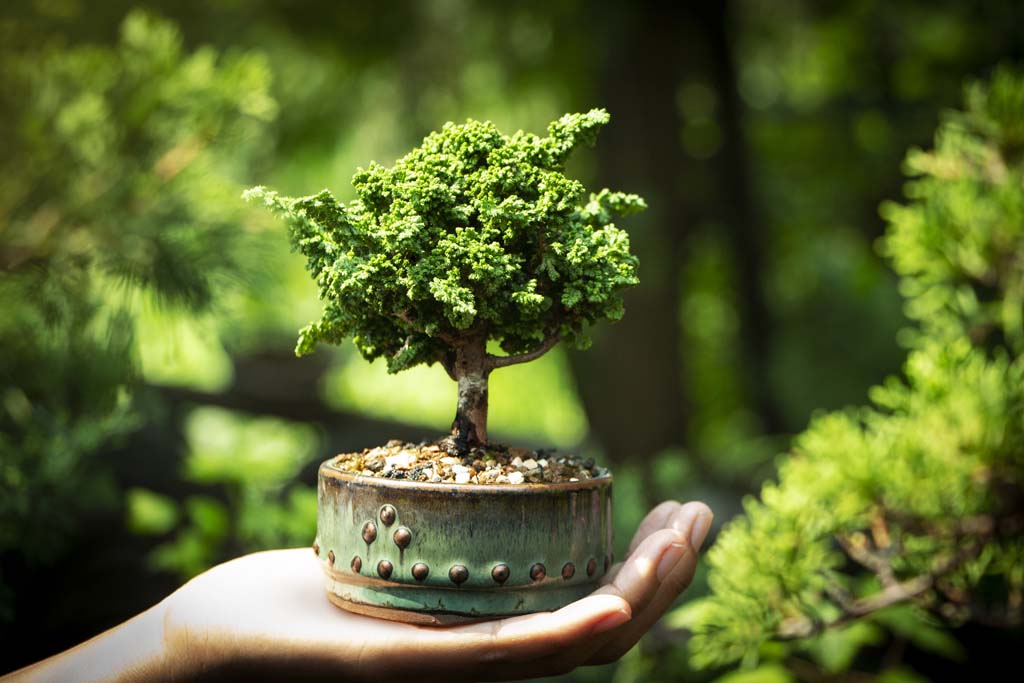
Bonsai
Learn to create different styles of bonsai. Know how to choose suitable plants then train and maintain them to produce a living work of art. An in-depth course for passionate amateurs or professional gardeners and nursery operators.
Learn about Bonsai by Distance Education
 This comprehensive course in Bonsai covers the many aspect of selecting, growing and maintaining Bonsai under a range of conditions.
- Learn about the styles and techniques for pruning and training used to create bonsai plants
- Learn to identify more plants, and to select specimens suited for creating bonsai
- For passionate hobbyists, through to anyone wanting to operate a bonsai nursery
- 100 hour, self paced course -tuition by expert horticulturists from both the UK and Australia
Creating Bonsai follows the 20/80 rule.
"As with most things in horticulture; growing bonsai requires 20% knowledge that is specific to bonsai (ie. equipment, techniques, using the right plants, understanding the traditional forms); and 80% general horticultural skill (ie. soil, nutrition, water management, pest control, plant identification, etc)"
Aims
- Demonstrate knowledge of the plant kingdom, an understanding of the taxonomic hierarchy, and an appreciation of the types of plants suitable for bonsai.
- Understand methods of propagation used in bonsai.
- Learn the species of plants most suited to bonsai.
- Learn a range of bonsai styles and techniques used to achieve them.
- Understand the process of creating bonsai.
- Understand the basics of successful bonsai culture.
- Understand landscape design principles to better create bonsai landscapes.
- Carry out research into a particular aspect of bonsai of interest to the student.
What You Will Do
- Develop plant review sheets for different plants suitable for bonsai.
- Make up a list of resources/contacts useful to a bonsai grower.
- Research what constitutes a good propagating mix.
- Visit a nursery and observe the nursery stock present to assess suitability for bonsai production.
- Propagate different species of plant that have the potential to be used as Bonsai.
- Select different plants and determine the style of bonsai each plant lends itself to.
- Make a list of the most commonly grown varieties of plants you consider as being used for bonsai today.
- Visit a bonsai house, bonsai farm, bonsai nursery or other facility where bonsai are available for viewing and classify the style of different bonsai plants.
- Evaluate, prune, wire, shape and pot different plants as bonsai.
- Obtain soil from two different types of soils; test the soils for drainage, and name the soils.
- Obtain (or make up) a potting mix which you consider appropriate for growing bonsai in.
- Conduct tests to name the potting mix you have obtained. Test the drainage of the potting mix.
- Visit a nursery or garden growing bonsai plants to assess the plants for pests, diseases and environmental anomalies.
- Design a miniature garden pot incorporating a bonsai plant
- Using your knowledge of landscaping principles, decide on the best outdoor locations three different bonsai, and the optimum indoor locations for short term display. Take photographs or sketch the locations in which you would place the bonsai. Submit these photographs with your assignment.
- Obtain plants of different varieties and using what you have learned in the course, turn your chosen plants into bonsai and either photograph or draw what you have created; then report on this work.
Lesson Structure
There are 8 lessons in this course:
-
Introduction
- Plant Taxonomy Botanical/Horticultural Nomenclature, The Binomial System, Botanical Classification, Plant Families and Species, Hybrids, Varieties and Cultivars
- Pronunciation of Plant Names
- Groups of Plants
- Resources reference books, organisations, magazines and journals, nurseries, bonsai shops, seed suppliers and the internet.
-
Propagation
- Introduction
- Methods of Propagating Plants sexual propagation, asexual propagation
- Seed Propagation collecting seed, storing seed and sowing seed
- Cutting Propagation stem cuttings, hardwood cuttings, semi-hardwood cuttings, leaf cuttings, leaf bud cuttings, root cuttings, factors affecting rooting of cuttings, striking cuttings, after care.
- Propagating Mixes and potting mixes
- Other Propagation Methods layering, air layering and grafting.
-
Plants for Bonsai
- Introduction
- History of Bonsai
- Types of plants suited for use as Bonsai sourcing Bonsai material
- Some plant choices
-
Bonsai Styles and Techniques
- Classification of styles of Bonsai eg. formal upright, informal upright, slanting or leaning, semi cascade, cascade
- Other styles of classification eg. sakei
- Japanese classification
- Bonsai Techniques
- Bonsai Containers preparing the container
- Wire wiring a bonsai
- Pruning
- Tools needed for Bonsai work pruning tools, potting tools and wiring tools.
-
Creating Bonsai
- Principles of Design roots, trunk and branches.
- Evaluating the Bonsai and assessing additional features
- Pruning and shaping the bonsai plant prune and grow techniques
- Wiring wiring techniques and grooming
- Branch Patterns in Bonsai jins, shari and driftwood
- Root Evaluation in the Initial Stages of Bonsai potting the Bonsai, rock planting, clasped to rock design and root over rock.
-
Bonsai Culture and Maintenance
- Soils Soil composition, colloids, structure, texture, chemical properties, improving soils, improving texture, improving structure, improving fertility.
- Soil for potted bonsai principle components
- Particle characteristics particle size, sorting, particle shape, particle surface texture
- Growing Medium Mixture functions of a growing medium, properties of a growing medium, drainage, water retention and colour and appearance.
- The Nutrient Elements macronutrients and micronutrients
- Common Pest Problems on Bonsai eg. aphids, borers, caterpillars, scale and thrips.
- Common Fungal Diseases of Plants eg. Anthracnose, Powdery Mildew and Rust
- Watering and Fertilising Bonsai symptoms of water deficiency, symptoms of excess water and fertilising.
- Repotting and Root Pruning the Bonsai
- Maintenance Pruning for Bonsai removing dead/diseased wood, controlling the type of growth, controlling shape and size, rejuvenating, leaf cutting, basic rules of pruning, points to consider when pruning.
- Placing the Bonsai
-
Landscaping Principles for Bonsai
- Principles of Landscape Design - Unity, Balance, Proportion, Harmony, Contrast and Rhythm
- Qualities of Landscape Components - line, form, mass, space, texture, colour and tone
- Creating Landscape Effects
- Landscape Applications for Using Bonsai - group plantings, saikei, bonseki, bonkei, miniature gardens, rock gardens, water gardens.
- Bonsai in Tubs and Landscape Features
-
Special Assignment
- Research a particular aspect of bonsai of interest.
Accreditations
What are the Different Types of Bonsai?
There are different ways of classifying bonsai. One way (used in Japan) is as follows:
- Chokkan (straight trunk) - one straight trunk, with an even taper from the base to the top. Once established the lowest branches commence at about one quarter of the way up the trunk from the base. Branches alternate from side to side as you progress up the trunk.
- Shakan (bending trunk) - a single main trunk leaning slightly to the left or right.
- Bankan (curved trunk) - a single twisted trunk (e.g. bending in 4 directions).
- Sokan (twin trunk) - a single tree with two separate trunks, one longer and thinner than the other.
- Saikei - a living landscape: often combining plants, rocks and water.
- Kabudachi (group of trees) - several trees growing together (up to 9). The bases are all together so they might almost appear to be the same tree. Trunks are branched on each tree to form odd numbers (1, 3, 5 etc. trunks) per tree.
- Netsuranari (several trunks from the one root) - one plant that is split into several trunks at the base. There are usually between 3 and 5 trunks, but never more than 10.
- Yoseue (collective plantings) - several plants in one container to give the appearance of a forest.
- Kengai (drooping trunk) - a tree leaning to one side, and contorted. This is copying the appearance of trees growing in exposed conditions such as a rocky outcrop on a mountainside. These plants can be unstable, which is a disadvantage when displaying them.
- Ishizuki (tree with a stone) - the roots of the tree grow over the top of a rock and into the soil below.
- Suiseki (stone without plant) - here a stone, or several stones, is arranged in the bonsai pot without any plants at all.
Choosing a Container
- Deeper pots have fewer air spaces between the soil particles. The weight of the soil on top squashes the soil underneath. Deeper pots therefore need a more open soil mix.
- Wider containers are more stable (less likely to tip over).
- A pot needs to have a sufficient number of large drainage holes to allow water to drain quickly away from the bottom of the pot.
- Roots tend to coil more in a round pot than a square pot.
- Root coiling at the bottom of a pot is reduced if the base is more tapered.
- Roots tend to grow through the bottom of pots when there is moist soil, compost or mulch under the pot. Pots are therefore best stood on top of a dry, paved or flat stone surface.
- Sprinkling a layer of coarse sand over the pot surface will reduce weed problems, and control the growth of moss.
Choosing a Bonsai Container
All bonsai containers will have drainage holes, and occasionally containers will have sealed compartments to hold water (to form a lake), or holes to poke wire through when re-potting the bonsai. Drainage holes are of paramount importance to enable sufficient root aeration. Waterlogged plants will not thrive, and may even die. If you like the look of a container without drainage holes, then drill some into the base.
Traditionally, bonsai pots are made of clay based substances such as porcelain, stoneware, and terracotta. The inside of a bonsai pot should never be glazed, although the outside can be. Unglazed pots in earthy tones usually look more pleasing than bright colours, although bright colours can work provided that there is some unity with the contents. Subtle glazes can work well, or crackled and speckled glazes - but not with all specimens. In some countries, it is possible to obtain marble, soapstone and other stone type containers. There is also a range of other pot materials (even including plastic) that can be perfectly acceptable provided they meet the needs of the bonsai. Remember that the pot is an integral part of the bonsai.
Bonsai pots come in a wide range of sizes from as small as thimble sized mame pots to containers of eighteen inches in depth. Wide, shallow containers are well suited to group plantings and landscapes. Tall containers, which may be round, square, hexagonal, and so forth are best suited to cascade style plantings or semi-cascade bonsai. Plainer shapes such as these are better than more elaborate types, regardless of the bonsai style. A rectangular or square container would suit a more formal style than a round or oval container. Most bonsai specialist retail outlets offer a range of containers originating from the Tokaname area of Japan.
A bonsai container should have a width which is approximately the same as the spread of the branches. The tree should never look lost by placing it in a container which is too large for it, nor should it look too big for the container. As a very general rule of thumb, the depth of the pot should be approximately the same as the width of the base of the trunk, the obvious exception being the cascade shaped bonsai which require deeper pots to balance their cascading form. Another approximation is that a vertical tree needs a container that is two thirds to three quarters the height of the tree in width, or a horizontal tree needs a container that is two thirds to three quarters the width of the tree. Smaller containers need to be deeper in proportion to width than do wider containers in order to provide sufficient soil and water for the bonsai plants. One should also bear in mind when potting up bonsai that a dormant deciduous tree will look more expansive once it comes into leaf.
Some pots will be more effective with legs or a base stand. Such legs can assist with the drainage of a pot, as it raises the pot up above the level of the shelf. It is important that the pot is level to allow for optimum drainage. Uneven pot base stands can be corrected by filing or adding filler as needed. The bonsai display can be finished off by the addition of a bamboo mat or by placing it on a simple stone slab or plank of wood.
An integral part of bonsai is the container which is used to present the art form. The bonsai may remain in the same pot for several years or, in the case of older tress, for many years. It is important therefore that the pot suits the tree or composition within. You might like to think of it as being somewhat similar to a picture frame. It must complement and not take away from the picture by being too brightly coloured, too fancy, or too large. Likewise, a bonsai container must enhance the contents within. Although bonsai containers are usually quite shallow, it also needs to able to hold sufficient growing media for the plant. For instance, a fruit tree will need a deeper container in order that there is sufficient water for fruit development. They should also be frost proof so that they do not crack and break outdoors, and they must have adequate drainage holes.
WHY WOULD YOU STUDY BONSAI?
For some people, bonsai is a hobby and for others it is their life work.
If you are passionate about bonsai, it can become a business. Small backyard bonsai collections can grow into a lucrative part time business if that is what you desire. Many retail garden centres will have a bonsai section. Some buy in the bonsai they sell, but others may create their bonsai on site.
Some nurseries will specialize in bonsai, and others deal exclusively with bonsai plants.
If you learn to create bonsai properly and understand what you are doing, you will be able to pass on your enthusiasm for this art form to others; and that will generate customers.
You may enter this course for any number of reasons; but when you finish it, you will be aware of so much more about bonsai and will be seeing possibilities for an expanded hobby, business or career - well beyond what you see now.
Enrol using the automated procedure on this site or contact us via phone or email to ask questions and enrol with a real person.
You can enrol at anytime and start the course when you are ready. Enrolments are accepted all year - students can commence study at any time. All study is self paced and ACS does not set assignment deadlines.
Please note that if a student is being assisted by someone else (e.g. an employer or government subsidy), the body offering the assistance may set deadlines. Students in such situations are advised to check with their sponsor prior to enrolling. The nominal duration of a course is approximately how long a course takes to complete. A course with a nominal duration of 100 hours is expected to take roughly 100 hours of study time to complete. However, this will vary from student to student. Short courses (eg. 100 hrs duration) should be completed within 12 months of enrolment. Certificates, Advanced Certificates and Awards (eg. over 500 hours duration) would normally be completed within 3 -5 years of enrolment. Additional fees may apply if a student requires an extended period to complete.
If a student cannot submit their assignments for 6 months to ACS, they should advise the school to avoid cancellation of their student
registration. Recommencement fees may apply.
Simply click on the ENROL OPTIONS button at the top of this screen and follow the prompts.
You can see the course price at the top of this page. Click 'enrolment options' to see any payment options available.
You can pay by Credit Card, PayPal, Afterpay or bank transfer.
Yes! We have payment plans for most courses. Click 'enrolment options' to see the available payment plans.
We also have Afterpay that will allow you to pay for your course or payment plans in four instalments (if you are in Australia).
There are no entry requirements that you need to meet to enrol in our courses, our courses are for everyone.
If you are under 18, we need written permission from your parent/ guardian for your enrolment to continue, we can arrange that after you have enrolled.
You don’t need to purchase any additional resources to complete our courses.
What do I need to know before I enrol?
We aim to teach you the essentials without you having to purchase any specific computer program.
We recommend that you have access to a word processing program, such as Microsoft Word or Google Docs, so that you can easily complete and submit your assignments.
You sure can. We are here to help you learn whatever your abilities.
Yes, if you are enrolling in a Certificate or Advanced Certificate, you might be eligible for credits if you have evidence of your previous studies or relevant experience. More information is here.
We recommend that you are able to browse websites, send emails and conduct online research. You will need to be able to type and submit your assignments.
If you have limited computer skills, we can make special arrangements for you.
This is possible, it depends on the institution. We recommend that if you would like to use our courses that you contact the institution first. Our Course Handbook is a good resource for this.
Our courses are written in English and we only have English speaking academic staff. If you can read and complete your assignments in English, our courses are ideal for you.
Our courses are designed to build knowledge, hands on skills and industry connections to help prepare you to work in the area, running your own business, professional development or as a base for further study.
This course has been designed to cover the fundamentals of the topic. It will take around 100 hours to complete, which includes your course reading, assignment work, research, practical tasks, watching videos and anything else that is contained in the course. Our short courses are a great way to do some professional development or to learn a new skill.
It’s up to you. The study hours listed in the course are a rough guide, however if you were to study a short course (100 hours) at 10 hours per week, you could finish the course in 10 weeks (just an example). Our courses are self-paced, so you can work through the courses in your own time. We recommend that you wait for your tutor to mark and return your assignment before your start your next one, so you get the benefits of their feedback.
The course consists of course notes, videos, set tasks for your practical work, online quizzes, an assignment for each lesson (that you receive feedback from your tutor from) and ends in an exam (which is optional, if would like to receive the formal award at the end), using our custom built Learning Management System - Login.Training.
Our courses are designed for adults to gain professional development and skills to further their careers and start businesses.
Our custom online learning portal allows you to conduct your learning online. There may be practical tasks that you can do offline. You have the option of downloading your course notes or print them to read later.
There is also the option to pay an additional fee for printed course notes and or USB (availability limited to location and deliverability).
Yes, if you don’t have access to the internet, you can receive the course as paper notes or on a USB stick for an additional fee. We can also make alternative arrangements for you to send your assignments to us.
We offer printed notes for an additional fee. Also, you can request your course notes on a USB stick for an additional fee.
Yes, your tutor is here to help you. Simply post any questions you have in your login.training portal or contact the office and we can pass on a message to your tutor.
We are more learning focussed, rather than assessment focussed. You have online quizzes to test your learning, written assignments and can complete an exam at the end of the course (if you want to receive your certificate). You will not receive a pass/ fail on your course work. If you need to add more details on your assignment, we will ask you to resubmit and direct you where you need to focus. If you need help, you can ask your tutor for advice in the student room.
Each module (short course) is completed with one exam.
Exams are optional, however you must sit an exam if you would like to receive a formal award. You will need to find someone who can supervise that you are sitting the exams under exams conditions. There is an additional cost of $60 incl. GST for each exam.
More information is here
There are practical components built into the course that have been designed to be achieved by anyone, anywhere. If you are unable to complete a task for any reason, you can ask your tutor for an alternative.
When you complete the course work and the exam and you will be able receive your course certificate- a Statement of Attainment. Otherwise, you can receive a Letter of Completion.
You can bundle the short courses to create your own customised learning bundle, Certificates or Advanced Certificates. More information is on this page.
Yes, our courses are built to be applicable for people living anywhere in any situation. We provide the fundamentals, and each student can apply their own unique flair for their own interests, region and circumstances with the one-on-one guidance of a tutor. There is also a bit of student directed research involved.
Employers value candidates with industry skills, knowledge, practical skills and formal learning. Our courses arm you with all of these things to help prepare you for a job or start your own business. The longer you study the more you will learn.
ACS has an arrangement with OAMPS (formerly AMP) who can arrange Professional Indemnity from Australian and New Zealand graduates across all disciplines. Ph: 1800 222 012 or email acs@oamps.com.au.
Who are ACS Distance Education?
ACS Distance Education have been educating people for over 40 years.
We are established and safe- we have been in education for over 40 years.
We are focused on developing innovative courses that are relevant to you now and what you will need to know in the future.
We are focused on helping you learn and make the most of your experience.
You can enrol at any time, you can work on your course when it suits you and at your own pace.
We are connected to many industry bodies and our staff participate in continuous improvement and learning activities to ensure that we are ahead of what learning is needed for the future.
Our courses are not accredited by the Australian Government. However many of our courses are recognised and held in high regard by many industry bodies.
Our courses are written by our staff, who all have many years experience and have qualifications in their speciality area. We have lots of academic staff who write and update our courses regularly.
How do I enrol my staff/ sponsored students?
Yes, you can do a request for a bulk enrolment and request an invoice on our Invoice Request Form
We can prepare an invoice, quote or proforma invoice. Simply complete your details on our Invoice Request form
We can arrange bulk discounts for your course enrolment, please get in touch with us to discuss your needs.
Yes, we have many students who are in locked facilities, such as prisons or hospitals. We can cater by also offering paper notes at an additional cost.
What if I have any more questions or need more information?
We can assist you to find the right course for your needs. Get in touch with us via email (admin@acs.edu.au) call on +61 7 5562 1088 or complete our course advice form.
What if I change my mind?
Please get in touch with studentservices@acs.edu.au if you would like to be removed from our mail list.
If you would like ACS Distance Education to delete your information at any time (whether you are a customer or a prospective customer), please contact our privacy officer and we will process this ( admin@acs.edu.au ).
If students require a reproduction of their certificate, an electronic copy can be provided at a cost of AUD$35 incl GST. Printed copies are not available.
Course Contributors
The following academics were involved in the development and/or updating of this course.

Marie Beermann
Marie has more than 10 years experience in horticulture and education in both Australia and Germany. Marie's qualifications include B. Sc., M. Sc. Hort., Dip. Bus., Cert. Ldscp.

Rosemary Davies (Horticulturist)
Leading horticultural expert in Australia.
Rosemary trained in Horticultural Applied Science at Melbourne University. Initially she worked with Agriculture Victoria as an extension officer, taught horticulture students, worked on radio with ABC radio (clocking up over 24 years as a presenter of garden talkback programs, initially the only woman presenter on gardening in Victoria) and she simultaneously developed a career as a writer.
She then studied Education and Training, teaching TAFE apprentices and developing curriculum for TAFE, before taking up an offer as a full time columnist with the Herald and Weekly Times and its magazine department after a number of years as columnist with the Age. She has worked for a number of companies in writing and publications, PR community education and management and has led several tours to Europe.
In 1999 Rosemary was BPW Bendigo Business Woman of the Year and is one of the founders and the Patron, of the Friends of the Bendigo Botanic gardens. She has completed her 6th book this year and is working on concepts for several others.
Rosemary has a B Ed, BSc Hort, Dip Advertising & Marketing

John Mason (Horticulturist)
Parks Manager, Nurseryman, Landscape Designer, Garden Writer and Consultant.
Over 40 years experience; working in Victoria, Queensland and the UK.
He is one of the most widely published garden writers in the world.

Adriana Fraser (Horticulturist)
Over 30 years working in horticulture, as a gardener, propagator, landscape designer
, teacher and consultant. Adriana has spent much of her life living on large properties, developing and maintaining her own gardens, and living a semi self sufficient lifestyle. She has decades of practical experience growing her own fruit, vegetables and herbs, and making her own preserves. She is well connected with horticulture professionals across Australia, and amongst other things, for a period, looked after Australia's national collection of Thymus. Advanced Diploma in Horticulture, Advanced Certificate in Horticulture.

Climbing Plants
“A doctor can bury his mistakes, but an architect can only advise his clients to plant vines.” ― Frank Lloyd Wright This e-book is a wonderful guide to climbing plants. Complete with full colour photographs, it is ideal for the home gardening enthusiast, landscape designer, or architect.

Getting Work in Horticulture
Find out what it is like to work in horticulture; how diverse the industry is, how to get a start, and how to build a sustainable, long term and diverse career that keeps your options broad, so you can move from sector to sector as demand and fashion changes across your working life.

Growing Conifers
The great thing about conifers is they look good all year round. Most of them are grown for foliage, and in general, foliage remains the same pretty well all year. Unlike other trees and shrubs, you do not have a month of attractive flowers, followed by an obscure plant the remainder of the year. A brilliant blue of gold foliage conifer will be blue or gold month in, month out.
Trees and Shrubs
Useful for students, tradespeople already working in the field, or the home gardener who needs a quick reference when choosing plants for a garden.